UAE Web Design Trends 2026-27: What's Worth Adopting (And What Isn't)
.avif)
UAE Web Design Trends 2026-27: What's Worth Adopting (And What Isn't)
Every agency publishes the same ten web design trends each January and none of them say which ones are actually worth paying for.
This Suplex piece can say something most of that content can't: which predicted trends actually held up this year, judged specifically on whether they help UAE shoppers find, trust and buy, not whether they look modern.
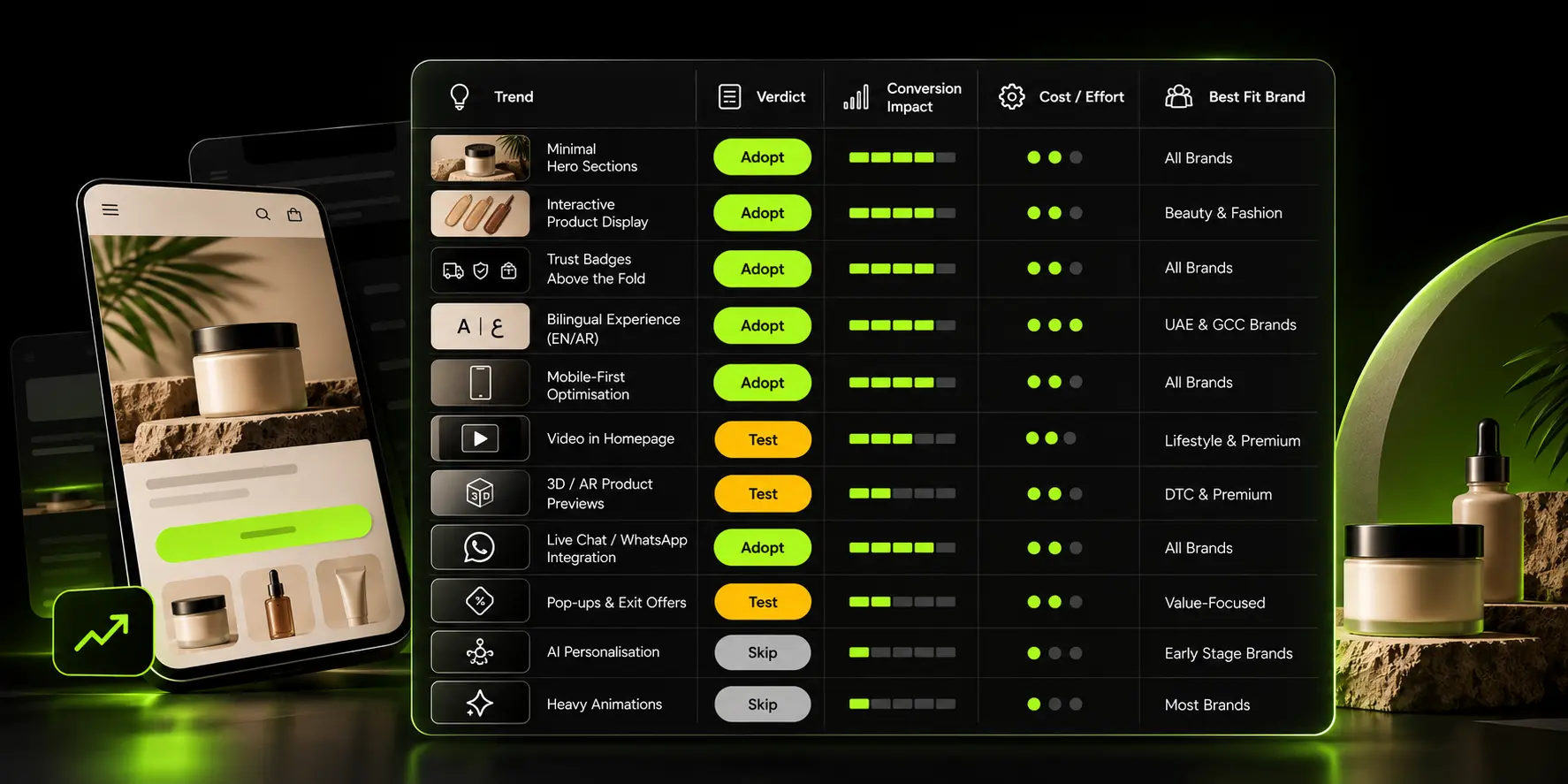
Each trend gets one of three verdicts: Adopt (do it now), Test (try it and measure), or Skip (not worth prioritizing for most brands).
How We Judged These Trends
Every trend below is scored against five questions: does it move conversion, what does it cost in time and budget, does it help or hurt page speed, is it actually relevant to how UAE shoppers behave, and is it still holding up now, roughly a year after most competing trend lists were written.
A trend that scores well on novelty but poorly on speed or conversion gets a Skip or a Test, not an Adopt, regardless of how often it shows up on other lists.
Trends To Adopt Now
These six are worth the budget and attention for essentially every UAE ecommerce brand.
Mobile-First Speed As The Design Constraint
Most UAE ecommerce traffic is mobile and arrives from social platforms, and speed should function as a hard constraint on every other design decision, image weight, script count and video autoplay, rather than an afterthought addressed once the design is finished.
Mobile traffic sits at roughly 59% of UAE web traffic as of mid-2026, and Google's current Core Web Vitals thresholds, a Largest Contentful Paint under 2.5 seconds, an Interaction to Next Paint under 200 milliseconds, and a Cumulative Layout Shift under 0.1, give a concrete bar to design against rather than a vague sense that "fast is good."
Our guides to Shopify speed optimization and ecommerce mobile optimization best practices cover the technical implementation in more depth.
Bilingual Design Built Properly, Not Bolted On
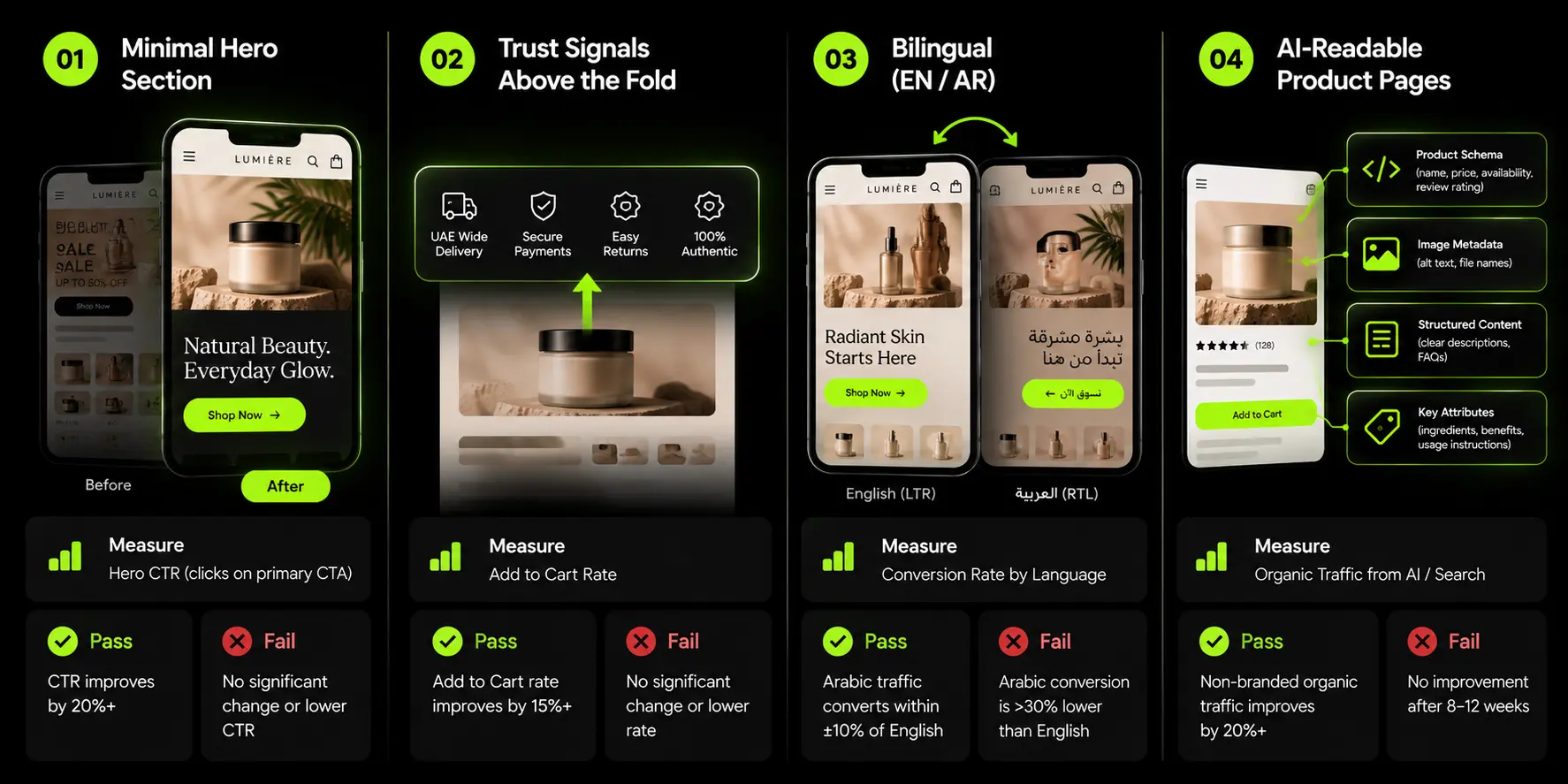
Mirrored right-to-left layouts, proper Arabic typography paired deliberately with the brand's English font, and Arabic copy written for Arabic readers rather than translated word for word are worth the investment for any brand serving a broad UAE or GCC audience.
The UAE Government Design System is genuinely raising the bar for Arabic typography and accessibility expectations in this market, even though it was built for government services rather than retail.
Our guides to bilingual Shopify store setup for the UAE and D2C localization for the Middle East cover the full implementation.
Local Trust Signals Designed Into The Page
Delivery times by emirate, cash on delivery, BNPL options like Tabby and Tamara, Apple Pay, and a clearly stated returns policy belong high on the homepage and product pages, not buried in the footer where a first-time visitor never scrolls to see them.
Suplex guide to D2C homepage design best practices for UAE brands covers exactly where these signals should sit.
Checkout And Payments Treated As Part Of The Design
Checkout design in the UAE continues to evolve, and it deserves the same design attention as any other page, not an afterthought handled purely by whichever payment app gets installed.
Faster wallet checkout through Apple Pay and Google Pay reduces friction meaningfully for mobile shoppers and most UAE stores still run a blended payment stack, a third-party gateway for mada, cards, and COD, alongside these wallet options, since native Shopify payment processing remains unavailable to UAE merchants as of this writing.
Designing checkout around this reality, rather than assuming a single native processor covers everything, is the practical version of this trend: a clean, uncluttered set of payment options presented clearly, rather than a confusing stack of redundant or poorly labeled choices bolted together as gateways were added over time.
WhatsApp As A Designed Channel
Placing WhatsApp deliberately for product questions, order updates, and abandoned-cart recovery, rather than adding a floating button as an afterthought once the rest of the site is finished, treats a channel UAE shoppers already trust as a genuine part of the customer journey rather than a bolt-on widget.
Designing For AI Search And Shopping Assistants
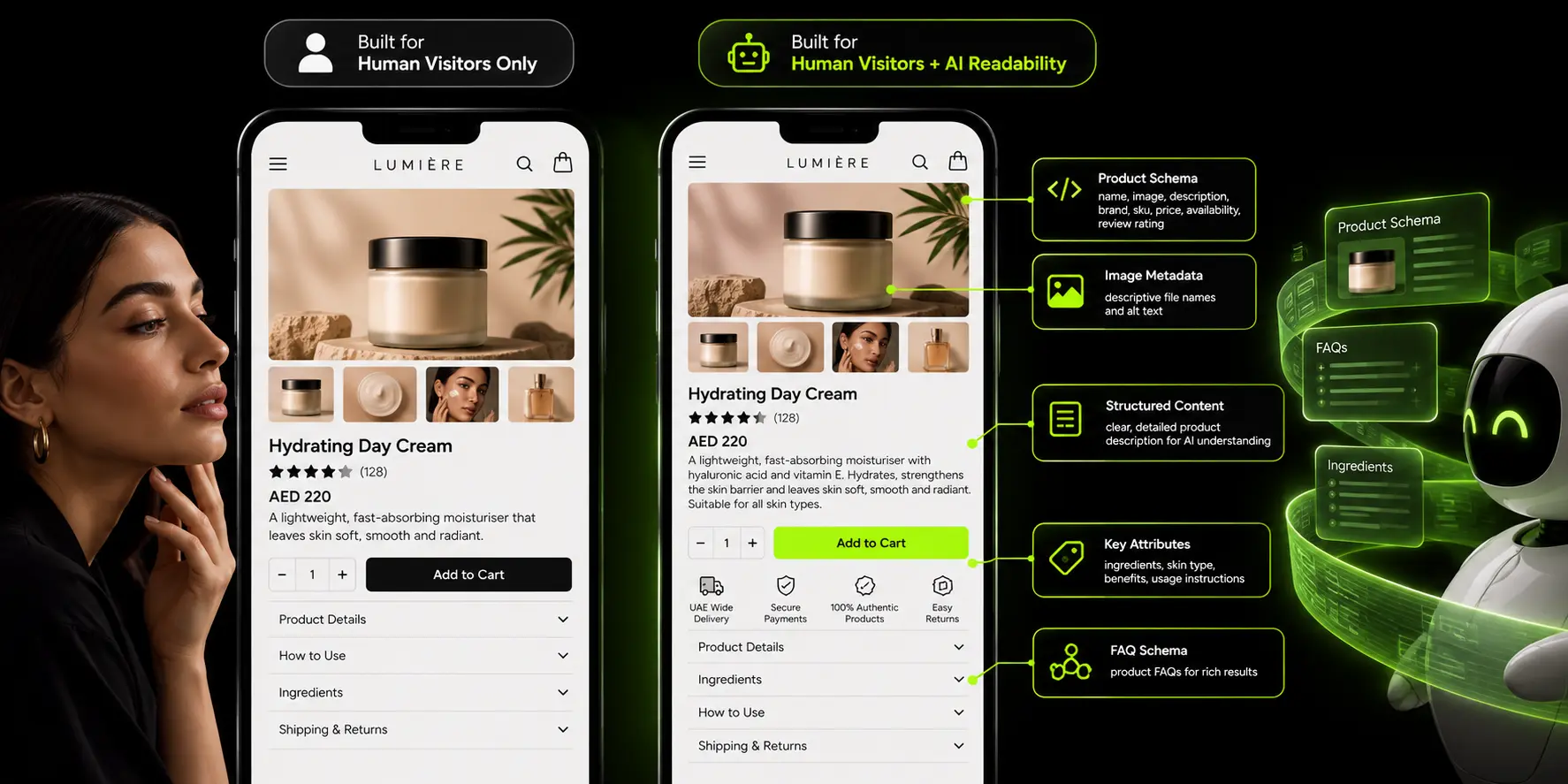
This is the most important forward-looking trend on this list. Clean site structure, complete and accurate product data, schema markup, answer-style content and fast server-rendered pages all determine whether AI Overviews, chat assistants, and shopping agents can actually read and recommend your store.
Some competing content calls this "machine experience," and the underlying idea, designing for a second audience beyond human visitors, is sound even if the specific terminology varies.
A product page with rich, accurate structured data is legible to an AI agent evaluating options on a shopper's behalf in a way that the same page's visual design, however polished, simply is not.
Confirm the current state of any specific agentic checkout or AI shopping features you plan to build around directly against the platform's current documentation, since this area is developing quickly and today's confirmed capability can shift. Suplex’s piece on how AI is changing ecommerce website design covers this shift in structural depth.
Trends Worth Testing
These four can genuinely help, but the right call depends on your specific catalogue, traffic, and brand, so measure rather than assume.
AI Product Recommendations And Personalisation
Genuinely useful once you have enough traffic and catalogue depth for the underlying algorithm to learn meaningful patterns; often close to useless, and sometimes actively distracting, for a small catalogue with limited data.
Test it directly against a simple, manually curated bestsellers block before assuming the more sophisticated option automatically wins.
Short Product Video And UGC On Product Pages
This matches how UAE shoppers already discover products on Instagram and TikTok, and it can lift conversion meaningfully for visually distinct products.
Weigh this against the page-speed cost video adds, and test the actual impact on your specific product pages rather than assuming video always helps.
Confident Minimalism
Fewer sections and more white space can genuinely raise clarity and perceived quality, but luxury and value-positioned brands respond to this differently.
A luxury brand often benefits from more breathing room around fewer, more deliberate elements; a value or high-volume brand often needs more visible content, categories and offers to serve how its customers actually shop. Test by brand position rather than applying one aesthetic universally.
Quizzes And Guided Product Finders
Strong for categories with genuine decision complexity, beauty, skincare, and supplements especially, where a shade or skin-type mismatch is a real return risk.
Weak for simple catalogues where the product choice is already obvious and a quiz just adds friction before checkout.
Trends Most UAE Ecommerce Brands Can Skip For Now
These four show up constantly on other trend lists, and for most UAE ecommerce brands they are not where the budget should go first.
Dark Mode As A Must-Have
Some competing content calls dark mode "no longer optional." For most ecommerce brands, that claim does not hold up.
Dark mode adds real design and maintenance cost, since every page and product image needs to work correctly in both themes, and there is little evidence it meaningfully improves sales for general retail.
Tech, gaming, and entertainment brands whose audience genuinely expects it are the clear exception; for most UAE stores, the same budget spent on speed or trust signals delivers more.
Organic, Grid-Breaking Layouts
These work well for portfolio and brand-story sites where visual distinctiveness is the point. On product listing pages specifically, scannable grids still convert better, especially on mobile, where a shopper is scanning quickly rather than admiring a layout.
Save the experimental layout for a campaign page, not the core catalogue browsing experience.
Heavy 3D, WebGL, And Scroll-Triggered Animation
These cost page speed, which directly hurts conversion for social traffic arriving on mobile data, exactly the audience most UAE D2C brands depend on most.
Reserve this kind of treatment for a standalone campaign landing page rather than the core store, where speed matters more than spectacle.
AI Chatbots As The Main Support Channel
UAE shoppers already default to WhatsApp, often expecting a human on the other end. A chatbot that stands between a shopper and an actual person tends to hurt trust rather than build it in this specific market, even though AI-assisted support has genuine uses elsewhere in the funnel.
Skip, in every case above, means skip as a current priority, not skip forever. Spend the budget on the Adopt list first, and revisit these once the fundamentals are genuinely covered.
What's Coming In 2027
This section is outlook, not confirmed fact, and should be read that way.
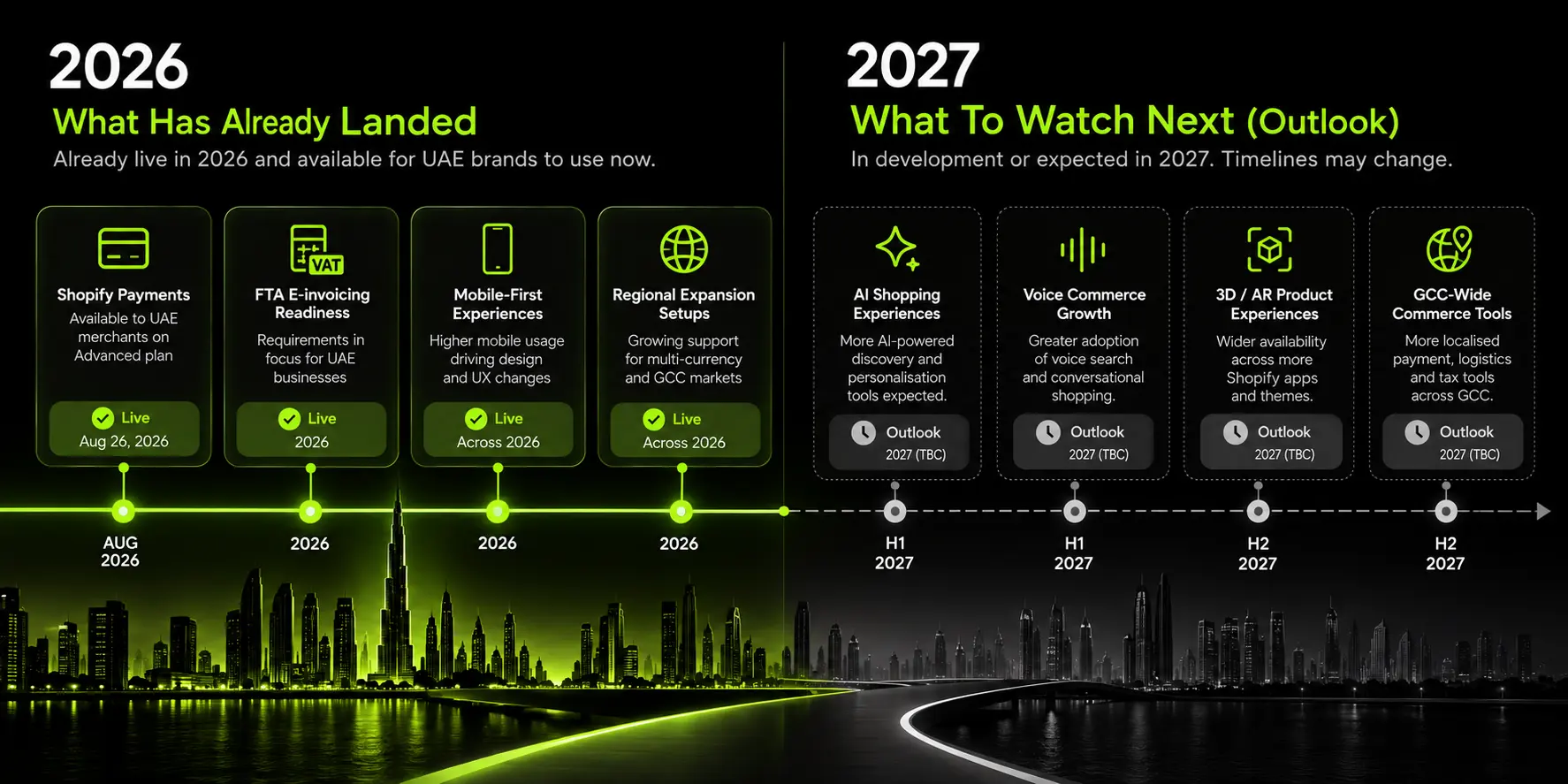
AI shopping agents making purchases on a customer's behalf are likely to keep expanding, which means stores increasingly need to be "agent-ready," structured data, reliable APIs, accurate product information, alongside the human-facing storefront.
Confirm any specific agentic commerce or checkout feature directly against current platform documentation before building around it, since this space is moving quickly and today's roadmap item is not the same as today's shipped feature.
Accessibility is likely to keep moving from a nice-to-have toward an expected baseline, following the same trajectory bilingual and mobile-first design have already taken in this market.
Faster, simpler payment and checkout options are likely to continue reducing the design surface of checkout itself, meaning less custom checkout design work over time and more emphasis on which payment methods are actually offered.
How To Apply These Trends Without A Full Redesign
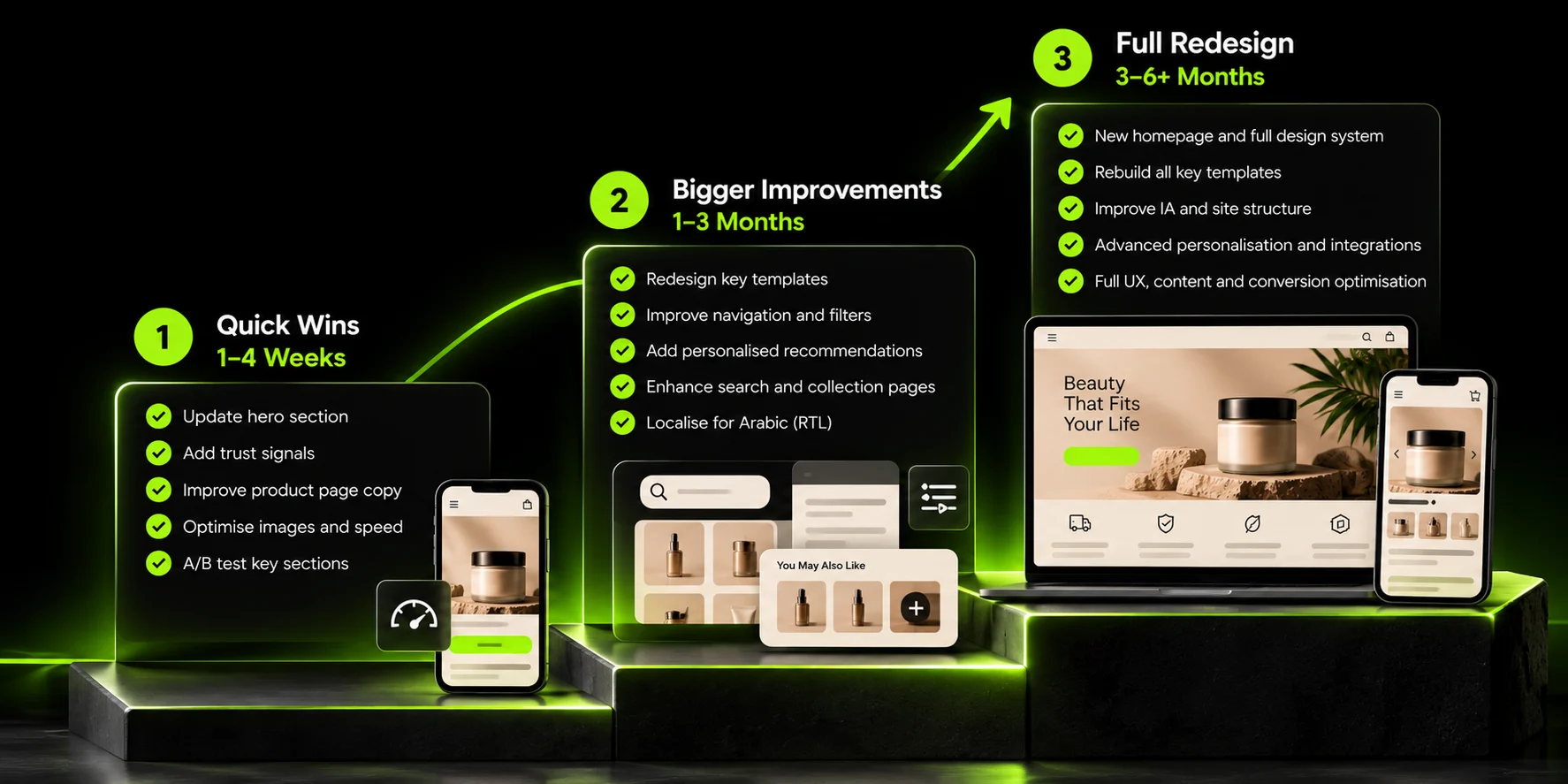
Most of the Adopt list does not require rebuilding the site from scratch.
Quick Wins In Weeks
Moving the trust strip higher on the page, repositioning WhatsApp deliberately, compressing images for speed and moving payment icons out of the footer and into the trust strip are all changes a small team can make without a full redesign project.
Medium Projects
A proper bilingual build with genuinely mirrored RTL layouts, a checkout redesign around your actual payment stack, and structured product data and schema markup for AI readability are bigger undertakings, but still short of a full site rebuild.
When A Full Redesign Actually Makes Sense
A full redesign is justified when the underlying platform or site structure itself is the constraint, not when a trend list suggests it. Our guide to signs your ecommerce website needs redesign and our ecommerce website redesign checklist for UAE brands both help you make that call based on actual evidence rather than trend pressure.
How We Apply Design Trends For UAE Ecommerce Brands
Our approach at Suplex judges every trend on conversion and speed impact for the specific brand in front of us, not on how novel or widely covered it is elsewhere.
We build bilingual and mobile-first as standard practice, not a premium add-on, and we structure stores for AI search readability as part of the same process, not a separate initiative bolted on afterward.
We will also tell a client directly when a trend is not worth their current budget, dark mode for a general retail brand, heavy animation on a store depending on fast-loading social traffic, rather than selling whatever is currently fashionable.
If you want a trend audit against your own store, showing what you already handle well and what to fix first, Suplex is happy to run one.
Frequently Asked Questions
What are the biggest web design trends in the UAE for 2026?
The trends with the most business impact are mobile-first speed, properly built Arabic/English bilingual design, visible local trust signals (delivery, COD, BNPL, WhatsApp), payment-friendly checkout design, and structuring sites so AI search and shopping assistants can read them. Visual trends like dark mode and experimental layouts get attention but usually deliver less for ecommerce brands.
Is dark mode necessary for a UAE website in 2026?
For most ecommerce brands, no. Dark mode adds design and maintenance work, since every page and product image needs to work in both themes, and there's little evidence it improves sales for general retail. It can make sense for tech, gaming, or entertainment brands whose audience expects it. For most stores, speed and trust signals are a better use of the budget.
How is AI changing web design in the UAE?
In two main ways. AI tools are speeding up design and content production, and AI search tools and shopping assistants are becoming a new way customers find products. The second matters more for ecommerce: stores with clear structure, good product data, and schema markup are easier for AI tools to understand and recommend. On-site AI features like chatbots and recommendations are worth testing, not assuming.
Should my website be in Arabic and English?
If you sell to a broad UAE or GCC audience, a proper bilingual site usually helps, especially for reaching Emirati and wider Arab customers. "Proper" is the key word: a mirrored right-to-left layout, Arabic-appropriate typography, and content written for Arabic readers. A poorly translated Arabic version can do more harm than an English-only site.
How often should I redesign my website to keep up with trends?
Full redesigns every three to five years are common, but you don't need one to keep up. Most important trends, such as trust signals, speed improvements, WhatsApp placement, and schema, can be added to an existing site. Redesign when the platform, structure, or brand no longer fits, not because a trend list says so.
Do web design trends affect SEO?
Some do. Speed, mobile usability, clear page structure, and structured data all affect how search engines and AI tools rank and read your site. Purely visual trends, such as colour palettes or layout styles, have little direct SEO effect, and heavy animation or 3D can hurt rankings indirectly by slowing pages down.
What web design trends matter most for ecommerce specifically?
For online stores, the trends that matter are those that affect whether shoppers trust you and complete a purchase: fast mobile pages, clear delivery and payment information, easy returns, good product photography and video, a smooth checkout, and product pages that AI shopping tools can read. Visual trends are secondary to these.
Final Thoughts
The trends that actually matter for a UAE ecommerce brand in 2026 are practical, not visual fashion: speed, language done properly, trust signals placed where shoppers actually look, payment options that match how people here actually pay, and site structure that AI tools can read.
Adopt those six first, test the four that depend on your specific catalogue and audience, and deprioritize the rest until the fundamentals are genuinely covered.
If you want a clear-eyed read on where your own store stands against this list, Suplex is happy to run a trend audit before you spend budget on anything.
Hi, I’m Rishabh Jain
I believe great design has the power to shape perception, build trust, and move businesses forward. That belief is what led me to found Suplex Design Studio, a global branding and packaging studio working with FMCG and D2C brands across markets.I started suplex at 25 with a clear intent, to create design that is strategic, thoughtful, and commercially meaningful. By 28, the studio had scaled globally, guided by a strong foundation in Integrated Design that I developed during my academic journey in London, where I was honoured with the Dean’s Award.
Over the years, I’ve had the opportunity to work with 100+ brands, from Fortune 500 organizations to family-run businesses, helping them build packaging and brand systems that create recall, relevance, and long-term value.
Suplex’s work has been recognized internationally, including the Manifest Award (2024), the Clutch Global Award (2025), and features on platforms such as Packaging of the World, The Dieline, and the World Brand Design Society.
None of this would be possible without the people behind the work. I’m deeply grateful to the suplex team, whose commitment, creativity, and attention to detail turn ideas into meaningful brand experiences every day.
At the heart of my work is a simple philosophy, design should be intentional, honest, and built to last, and that continues to guide everything we create at suplex.



















Let’s Make It Happen
E-Commerce Success Stories
%201.avif)






.avif)
.avif)
Build Your D2C Business The Right Way
Build It With Suplex.


