Arabic-English Ecommerce Website Developers In The UAE: How To Tell A Real Bilingual Build From A Translated One

Arabic-English Ecommerce Website Developers In The UAE: How To Tell A Real Bilingual Build From A Translated One
Arabic-English ecommerce website developers in the UAE often promise bilingual stores, but many simply translate the English storefront.
The result? Arabic menus with English checkout pages, error messages and order confirmations. A genuinely bilingual store needs more than translated text. It must deliver a consistent shopping experience in both languages.
As an experienced Dubai based ecommerce agency, here's our guide to explaining what to look for, how to evaluate a developer's portfolio in 10 minutes and what to include in your development contract.
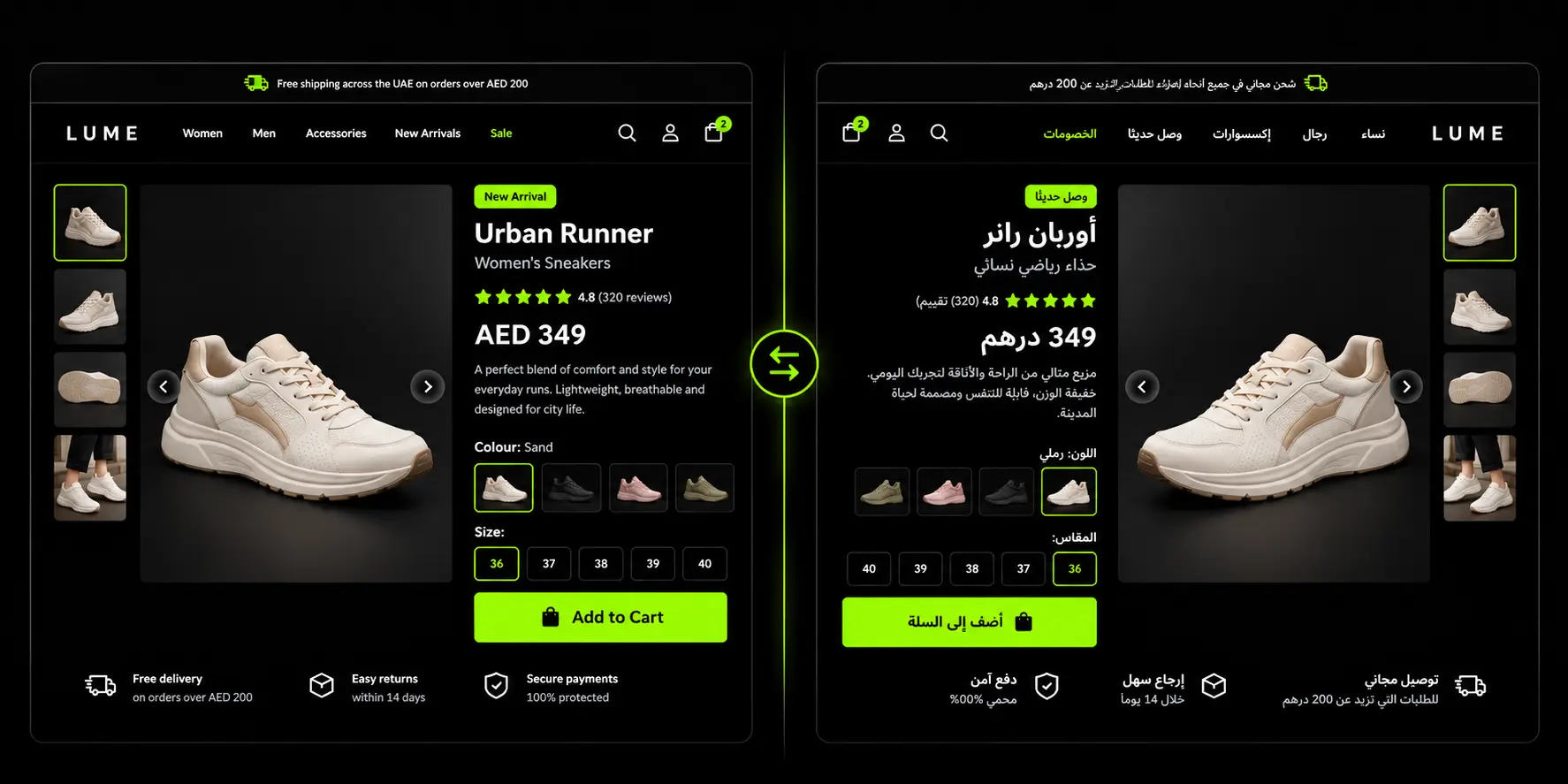
What “Bilingual” Means When Developers Quote It
The term “bilingual” can describe anything from an auto-translated storefront to a fully localized Arabic-English shopping experience.
Understanding the difference helps you compare UAE developers' quotes fairly and avoid paying for a solution that doesn't meet your customers' needs.
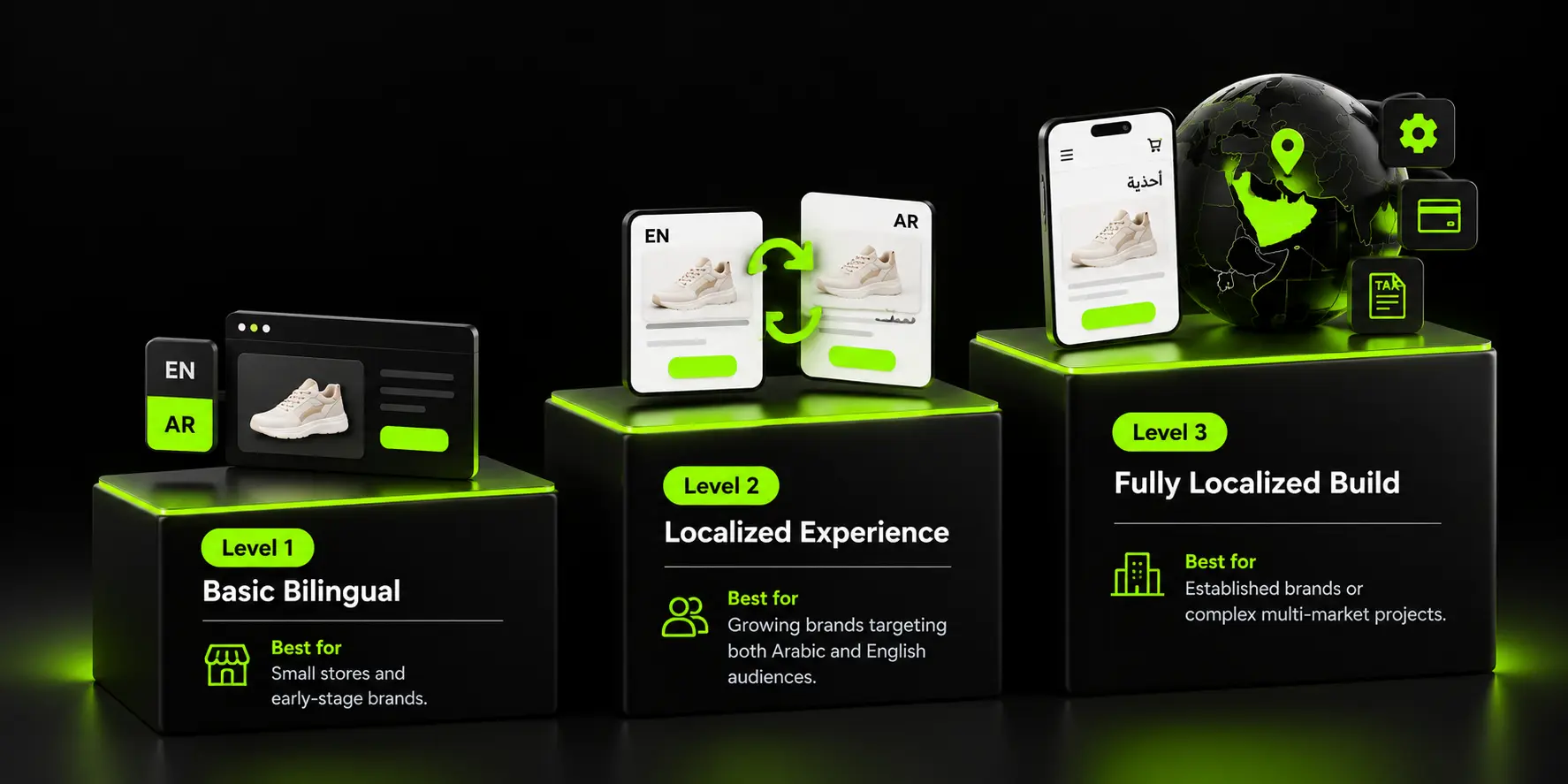
The Three Levels of Arabic-English Ecommerce
Some UAE providers advertise Arabic websites from around AED 1,000, but these entry-level packages may offer little more than translation and basic RTL adjustments. Compare the actual deliverables, not just the quoted price.
Shopify apps such as RTL Master and Aulingo RTL can help adapt themes for right-to-left layouts. However, flipping a design does not guarantee natural Arabic copy, a properly localized checkout, or correctly translated app notifications.
How to Choose the Right Level
Base your decision on customer data and business goals, including:
- Arabic-Language Traffic: What share of your website sessions comes from visitors using Arabic?
- Target Markets: Are you serving UAE customers exclusively, or planning to expand into Saudi Arabia?
- Buyer Expectations: Do your government or enterprise clients require Arabic-language content and communication?
- Customer Support: How often do customers contact you through WhatsApp or other channels in Arabic?
If most of your customers prefer English and Arabic traffic is limited, a localized bilingual store may be sufficient.
If Arabic-speaking customers are central to your growth strategy, or you're targeting Saudi Arabia, investing in an Arabic-first approach may make more sense.
The right choice also depends on how well your store handles Arabic typography, navigation, and product presentation. These Arabic ecommerce website design principles can help you identify what your developer needs to get right before the project begins.
Where Arabic-English Ecommerce Builds Break
An Arabic storefront can look polished on the homepage and still fail when customers search for products, complete checkout, or receive order updates.
These problems often sit in the theme, third-party apps, and connected systems rather than the visible design.
Layout and Direction : A proper right-to-left (RTL) layout goes beyond aligning text to the right. Menus, breadcrumbs, navigation arrows and carousels must behave correctly in Arabic. Some elements, such as logos and play buttons, should retain their original orientation.
Test interactive elements, not just static pages. Open the navigation menu, expand a filter, and swipe through a product gallery to check whether the layout behaves naturally in Arabic.
Mixed-Direction Text: Prices, SKUs, phone numbers, dates, and Latin brand names can appear in the wrong order when placed inside Arabic text. Punctuation and brackets can also shift unexpectedly.
Ask your developer to test mixed-direction content and establish a consistent approach to Western or Arabic-Indic numerals across product pages, checkout, and customer communications.
Typography: Arabic needs suitable fonts, weights, spacing, and line height. A typeface that looks clean in English may appear cramped or uneven in Arabic.
Italic styling is another consideration. Arabic does not have a conventional italic style equivalent to Latin script, so artificially slanted text can look awkward.
Your developer should adapt the typography rather than simply applying the English design rules to both languages.
Forms and Checkout: Checkout is one of the most important places to test. Name fields may reject Arabic characters, address fields may not accommodate local address formats, and validation errors may remain in English.
Payment gateways and buy now, pay later (BNPL) providers also differ in their Arabic-language support. Check the complete payment journey, including any third-party screens or redirects, rather than assuming that an Arabic checkout guarantees an Arabic payment experience.
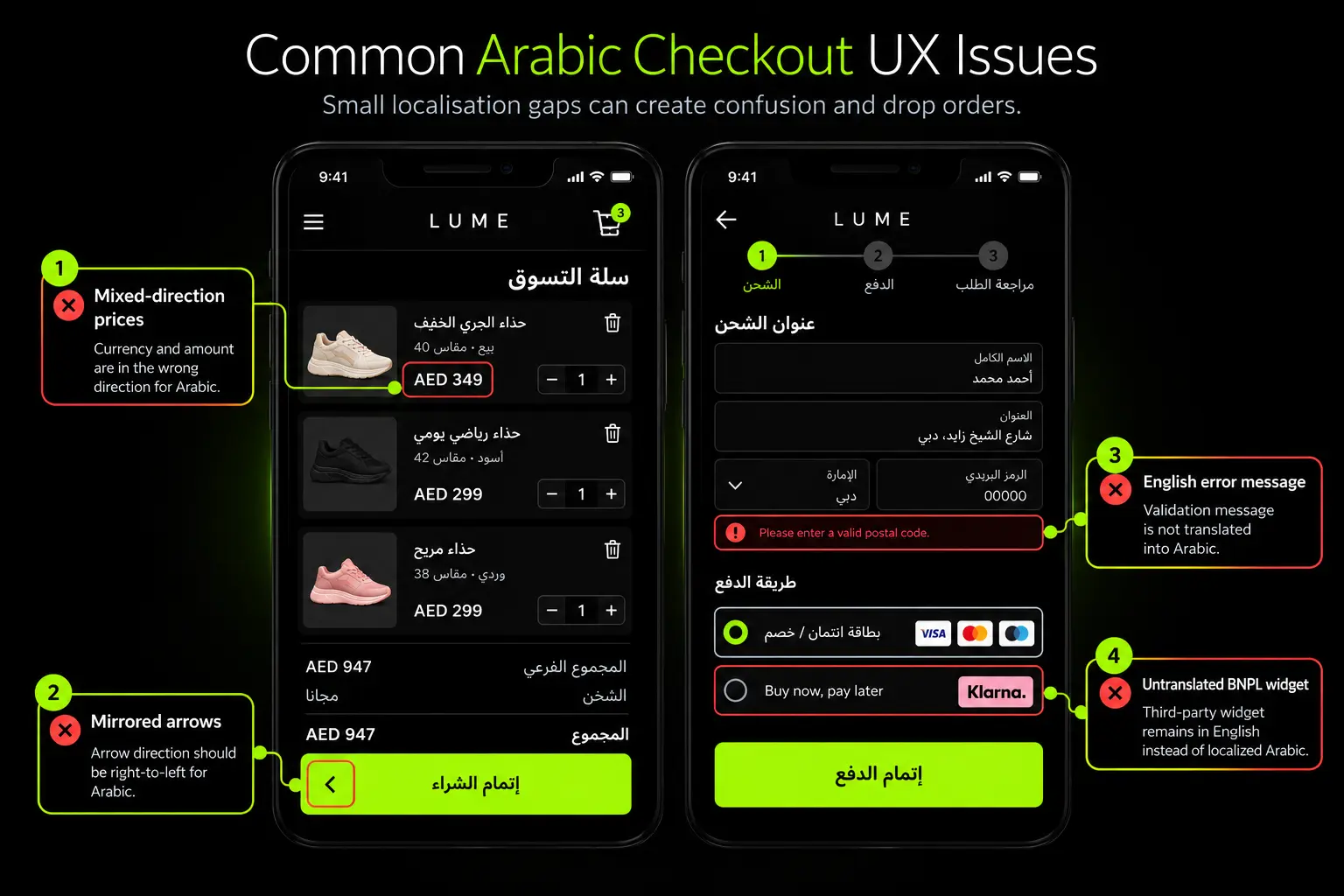
Apps and Widgets: On Shopify, translation tools can handle much of the product content and theme text, but third-party apps and custom sections may need separate configuration.
Review widgets, BNPL messages, promotional pop-ups, and chat tools can remain in English or display incorrectly in RTL layouts. Every new app or feature can introduce similar problems, which is why bilingual QA should continue after launch.
Notifications and Documents: The customer experience continues after checkout. Order confirmation emails, SMS messages, WhatsApp updates, invoices, packing slips and delivery notifications should support the language selected for the order wherever the relevant system allows it.
Ask your developer to demonstrate Arabic versions of these communications before sign-off. Courier updates and order-status pages deserve particular attention because they may come from separate systems with their own language settings.
Search: Arabic search needs to account for spelling variations and differences in how customers enter words. Variants of hamza, ta marbuta, and Arabic written in Latin characters (known as Arabizi) can affect whether shoppers find the products they want.
Ask how the developer tests Arabic search, which spelling variations the search system handles, and whether common customer queries return relevant results.
Shopify Platform Considerations: Shopify's Translate & Adapt supports Arabic translation, but translation alone does not guarantee a functional RTL storefront. The theme must also support right-to-left layouts, and individual apps may need additional configuration.
Check RTL compatibility before choosing a theme or finalizing the design. If an existing theme cannot support the required layout and interactions, a custom Shopify theme may be a better option than trying to fix limitations after development.
The 10-Minute Test for Any Developer's Arabic Portfolio
Before signing a contract, ask the developer for two live Arabic-English stores they have built. Open them on your phone and run these checks.
- Homepage: Switch to Arabic. Do the navigation, breadcrumbs, and carousel controls behave correctly?
- Product Page: Are prices, VAT details, and delivery estimates displayed clearly?
- Search: Search in Arabic, including a common spelling variation. Do relevant products appear?
- Cart: Are the cart drawer, promotional messages, and free-shipping thresholds translated?
- Checkout: Enter an invalid phone number. Does the error message appear in Arabic?
- Third-Party Apps: Do reviews, BNPL widgets, and promotional pop-ups work in Arabic?
- Policies: Is the returns policy available in Arabic, or does the link lead to an English page?
- URLs and SEO: Is there a dedicated Arabic URL structure, and are appropriate hreflang tags implemented?
- Customer Support: Is Arabic-language chat or WhatsApp support available where promised?
- Order Confirmation: Can the developer demonstrate an Arabic confirmation email or another post-purchase message?
How to Interpret the Score: Eight to ten passes suggest a stronger bilingual implementation, although you should still verify the underlying setup. Six or seven indicate areas that need further investigation. Fewer than six suggest substantial gaps in the Arabic customer journey.
The test is a screening tool, not a technical certification. A developer should also explain how the store handles translations, RTL compatibility, third-party integrations, and ongoing quality checks.

Arabic SEO: What Your Developer Should Set Up
Arabic SEO requires more than translating English pages. Keyword choices, search behaviour, URL structures, and metadata all need to work for Arabic-speaking customers. If your developer treats SEO as a translation task, important opportunities can be missed.
Separate Arabic Keyword Research
Arabic shoppers don't always search using direct translations of English product names. They may use Gulf dialect terms, alternative spellings, or Arabizi (Arabic written in Latin characters).
Research Arabic search queries separately and use the findings to shape product titles, collection names, page headings, and descriptions.
The Arabic version may need different wording and category names rather than a direct translation of the English storefront.
Language URLs and Hreflang
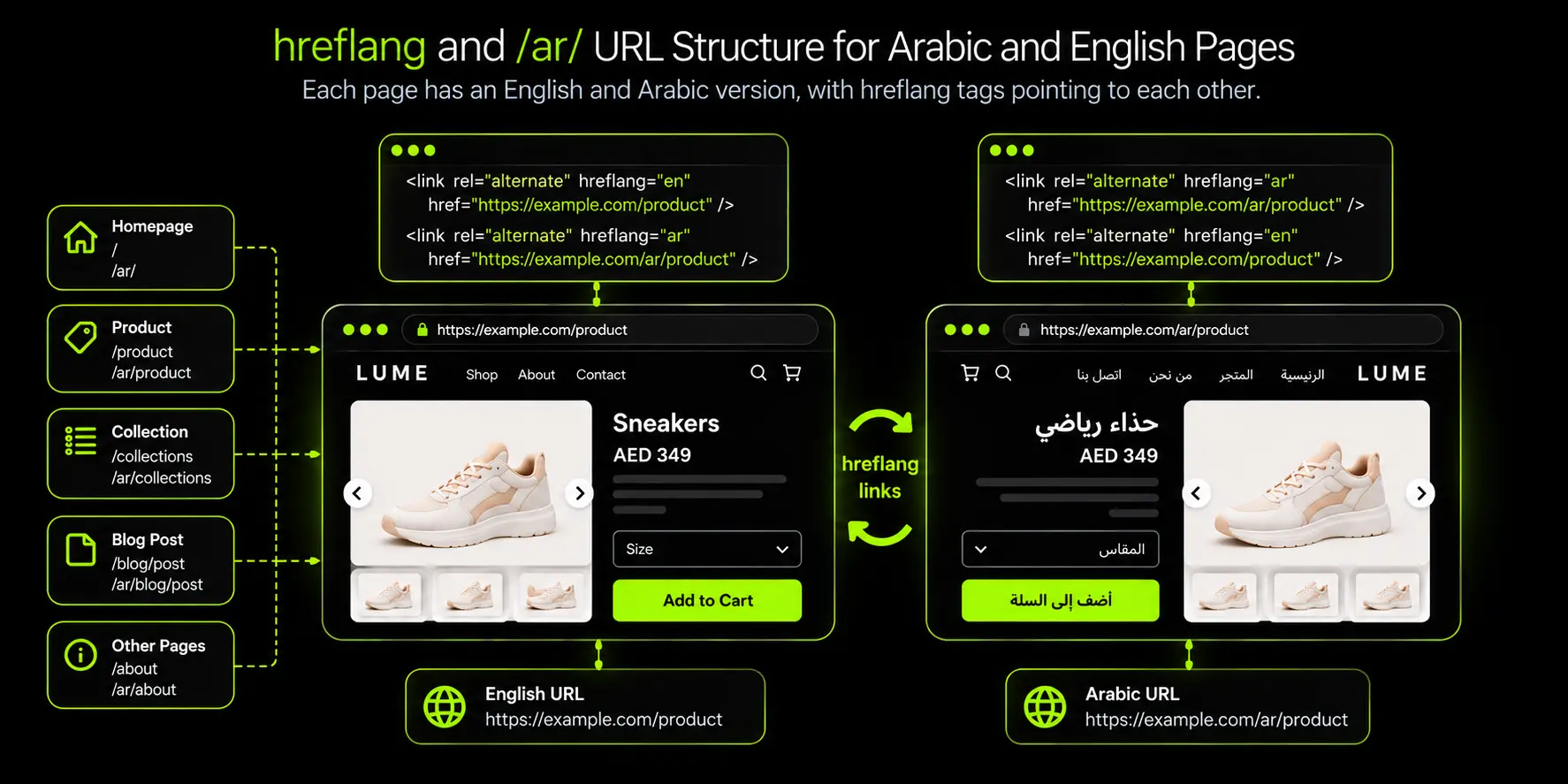
A common approach is to use language-specific subfolders, such as /ar/ for Arabic pages, with appropriate hreflang annotations connecting equivalent English and Arabic versions. These annotations help search engines understand which language and regional version to serve.
Shopify's language and market settings can handle parts of this setup, but your developer should verify the implementation. Ask to see the hreflang output and sitemap entries rather than assuming everything works automatically.
Arabic URL Handles
Product and collection URLs can use Arabic-script handles or transliterated Latin characters. Both approaches can work, provided the structure is consistent and manageable.
Agree on a URL convention before launch and document it for future products. Changing URL structures later can require redirects and additional SEO checks, so it's better to settle the approach early.
Metadata and Structured Data Per Language
Each language version needs SEO elements appropriate to its audience, including:
- Arabic page titles and meta descriptions based on Arabic keyword research.
- Accurate product information and structured data that match the relevant page.
- Arabic image alt text where it helps describe the image.
- Consistent language signals across page content, URLs, and technical SEO settings.
An Arabic page with English metadata can create a mismatch between the content customers see and the information presented in search results.
Your developer's quote should clarify who handles Arabic keyword research, metadata, structured data, and technical implementation. These tasks are often treated as separate from translation, so confirm the scope before work begins.
Arabic SEO also depends on how content is presented on the page. Typography, navigation, and content hierarchy affect how easily shoppers browse an Arabic storefront, particularly when product information and calls to action need to work naturally in a right-to-left layout. These considerations are also central to Arabic ecommerce website design.
Arabic URL Handles
You can use Arabic-script handles or transliterated Latin handles. Each choice has trade-offs for sharing, readability, and tools that handle Arabic links poorly.
What matters is that the choice is made on purpose and written down, so every new product follows the same rule. Changing the handle style after launch means redirects for every affected page, which is slow and easy to get wrong.
Metadata And Structured Data Per Language
Each language version needs its own page titles and meta descriptions in Arabic, its own product schema, and Arabic image alt text.
An Arabic page with English metadata sends mixed signals to search engines and to shoppers who see the search result.
Ask who writes this metadata and whether it is part of the quote, because it is often the first thing cut when a project runs short on time.
Choosing the Platform for a Bilingual Store
Your ecommerce platform determines how much Arabic-English functionality is built in and how much depends on themes, plugins and custom development. No platform makes a complete bilingual shopping experience automatic.
Which Platform Should You Choose?
Shopify is worth considering for D2C brands selling across the UAE and international markets. Its app ecosystem and market-management tools provide a useful foundation, although themes and third-party apps still need Arabic and RTL testing.
WooCommerce may suit businesses already using WordPress or needing greater control over their website. However, multilingual plugins and integrations require ongoing maintenance.
For brands targeting Saudi Arabia primarily, Arabic-native platforms such as Salla and Zid deserve consideration. Compare their language options, payment integrations and international selling capabilities against your requirements.
Custom or headless development makes sense when standard platforms cannot support your specific content structure or customer journey, and you have the resources to maintain it.
If you're comparing Shopify with WordPress, go through Shopify vs WordPress for ecommerce explains the key differences in flexibility, maintenance, and ecommerce functionality.
Whichever platform you choose, test the complete Arabic shopping journey before launch. If you're migrating an existing store, plan translated URL mappings, redirects, and SEO preservation early to avoid losing search visibility.
Questions to Ask Arabic-English Ecommerce Developers
Before hiring a developer, ask questions that reveal what their bilingual service actually includes. Specific answers and working examples are more useful than promises of full Arabic and RTL support.
- Which bilingual level are you quoting, and what is excluded?
- Who writes Arabic: a native copywriter, a translator, or machine translation with editing?
- Who tests the Arabic experience, and on which devices?
- How do you handle third-party apps and widgets that do not support RTL?
- Do order emails, SMS, WhatsApp messages, and invoices support the order's language?
- How do you test Arabic search and spelling variations?
- Does the quote include Arabic keyword research, metadata, and hreflang setup?
- Who owns the translations and glossary after launch?
- How will new products and campaigns be translated after launch, and what will ongoing updates cost?
A developer with relevant experience should be able to demonstrate these features on a live store. Ask to see an Arabic order confirmation, test search with spelling variations, and find out how new apps are checked before going live.
It's also worth asking how the agency manages the wider project, from scope and communication to testing and post-launch support. These details can reveal gaps that technical demonstrations alone may not uncover. For more ideas, see these questions to ask an ecommerce agency before signing a contract.
What to Put in the Contract
Bilingual projects can run into problems when the contract doesn't clearly define what the developer will deliver. Agree on these details before work begins to avoid unexpected costs and unfinished work.
- Bilingual Level: Specify whether the project covers basic translation, a localized bilingual store, or an Arabic-first experience.
- Arabic Deliverables: List the pages and features included, from the storefront and checkout to notifications, policies, and invoices.
- QA and Sign-Off: Define the Arabic testing checklist, supported devices, and process for fixing issues before launch.
- Translation Ownership: Confirm that you receive the translation files, glossary, and brand terminology at handover.
- Post-launch support: Agree on the cost and turnaround time for translating new products and updating campaigns.
Pay particular attention to the QA checklist. Use the 10-minute test earlier in this guide as a starting point, and specify which issues must be fixed before approval.
Also clarify whether updates to third-party apps, new features, and additional translations are covered by the original quote or charged separately.
Cost and Timeline for an Arabic-English Ecommerce Website
A bilingual ecommerce store usually costs more than an equivalent English-only build. The additional work typically includes:
- RTL theme adjustments
- Arabic copywriting and editing
- Testing across devices
- Fixing third-party app widgets
- Arabic search configuration
- Arabic SEO setup
Ask developers to separate the English build, Arabic implementation, and Arabic content costs in their quotes. This makes it easier to compare proposals and check whether testing and localization are included.
A bilingual project may add two to four weeks to an equivalent English-only build, based on the project's scope and our own project experience.
Treat this as an estimate, not a fixed timeline. Your catalogue size, number of apps, and level of Arabic localization can all affect delivery.
Most importantly, compare quotes for the same bilingual level. A basic translation layer and a fully localized Arabic-English store involve different amounts of work, so their prices shouldn't be compared directly.
The same principle applies when reviewing overall website budgets. Our guide to responsive web design costs in Abu Dhabi explains how project complexity, integrations, and customization affect pricing.
How Suplex Builds Arabic-English Ecommerce Websites
At Suplex, our Dubai-based team builds ecommerce websites for brands selling in the UAE and across the GCC. For bilingual projects, we consider Arabic from the design stage rather than treating it as a translation task after the English store is complete.
Our approach covers:
- Bilingual UX and Design: Arabic typography, navigation, and RTL layout rules.
- Theme development: Choosing an RTL-compatible theme or building custom functionality where needed.
- Checkout and Notifications: Checking Arabic support across the purchase journey and customer communications.
- Arabic search and SEO: Setting up search behaviour, metadata, keyword targeting, and hreflang.
- Quality Assurance: Testing the Arabic experience across devices before launch.
We also look at audience data before recommending how much to invest in Arabic. If Arabic-language traffic and customer enquiries are limited, a smaller initial implementation may make more sense than building a separate Arabic-first experience. The aim is to choose a setup your team can maintain after launch.
Our work for Tea Culture of the World, Miduty, and Great Lakes offers a look at projects we've delivered for different brands. The specific scope of each case study varies, so ask us about the requirements of your own bilingual store before deciding on an approach.
Frequently Asked Questions About Arabic-English Ecommerce Websites
What Is a Bilingual Arabic-English Ecommerce Website?
It is an online store where customers can browse, purchase, and receive order updates in Arabic or English. A proper bilingual store includes RTL layouts, translated checkout messages, policies, and notifications, along with Arabic metadata and hreflang tags.
Do I Need an Arabic Version of My Ecommerce Website in the UAE?
It depends on your audience. Arabic can be important for brands targeting Emirati customers, government buyers, or Saudi Arabia. Check your Arabic-language website traffic, customer enquiries, and target markets before deciding.
Can Shopify Support Arabic and Right-to-Left Layouts?
Yes. Shopify supports Arabic, and Translate & Adapt can help translate store content. However, your theme must support RTL layouts, and third-party apps, custom sections, and notification templates may need separate adjustments.
How Much Does an Arabic-English Ecommerce Website Cost in the UAE?
The cost depends on the level of localization, catalogue size, theme requirements, and integrations. A fully localized store requires more work than a basic translation setup. Compare quotes with the same deliverables and confirm whether Arabic copywriting, testing, and SEO are included.
Is Machine Translation Good Enough for an Arabic Ecommerce Store?
Machine translation can provide a starting point, but important content should be reviewed by someone fluent in Arabic. Product descriptions, checkout messages, policies, and notifications need accurate wording and consistent terminology.
How Do I Check If a Developer Can Really Build in Arabic?
Ask for two live Arabic stores and test them on your phone. Check the navigation, product search, cart, checkout errors, third-party widgets, and order notifications. Also verify the Arabic URLs and hreflang implementation. Ask the developer to explain how they test and maintain these features after launch.
Hi, I’m Rishabh Jain
I believe great digital experiences have the power to shape perception, build trust, and move businesses forward. That belief led me to found Suplex Design Studio, a global digital design and development studio helping FMCG and D2C brands build websites and digital experiences that are strategic, thoughtful, and commercially meaningful.
I started Suplex at 25 with a clear intent, to create digital experiences that look appealing, work seamlessly, and help D2C businesses grow. By 28, the studio had scaled globally, guided by a strong foundation in integrated design that I developed during my academic journey in London, where I was honoured with the Dean’s Award.
Over the years, I’ve had the opportunity to work with 100+ brands, from Fortune 500 organisations to family-run businesses, helping them build websites, e-commerce experiences, and digital products that create clarity, credibility, and long-term value.
Our work has been recognised internationally, including the Manifest Award (2024), the Clutch Global Award (2025), and features across platforms such as The Dieline, Packaging of the World, and the World Brand Design Society.
None of this would be possible without the people behind the work. I’m deeply grateful to the Suplex team, whose commitment, creativity, and attention to detail turn ideas into meaningful digital experiences every day.
At the heart of our work is a simple philosophy, digital design should be intentional, functional, and built to create real business value. That continues to guide everything we create at Suplex.























Let’s Make It Happen
E-Commerce Success Stories








Build Your D2C Business The Right Way
Build It With Suplex.


