Best Shopify Setup For UAE Beauty Brands: The Complete 2026 Guide
.avif)
Best Shopify Setup For UAE Beauty Brands: The Complete 2026 Guide
The best Shopify setup for a UAE beauty brand combines standard Shopify with a UAE compliant payment stack, VAT ready invoicing, bilingual Arabic and English product pages with proper RTL support, and a focused beauty app stack.
For most growing brands, Shopify standard is sufficient, while Shopify Plus is better suited to businesses with complex, high volume, or multi market requirements.
The setup should support local payment methods such as Apple Pay and relevant regional options, while preparing for GCC expansion where methods such as Mada may be required.
Beauty specific features can include ingredient information, shade matching, product recommendations, reviews, and subscriptions. With the right setup sequence, most brands can be launch ready within four to six weeks.
Shopify Vs. Shopify Plus For A UAE Beauty Brand: Which Do You Actually Need?
Most UAE beauty brands do not need Shopify Plus from day one. Standard Shopify is usually sufficient for a single D2C storefront, UAE focused operations and businesses without complex wholesale or multi entity requirements. Store speed, design quality, and a strong mobile experience can all be achieved with the right Shopify setup.
Shopify Plus becomes more relevant as the business scales. It can make sense when you operate multiple regional storefronts, sell wholesale to salons or retailers, require advanced B2B pricing, manage multiple brands or entities, or reach a level of sales where advanced automation and checkout capabilities justify the additional cost.
If you are unsure whether your business has reached that point, our guide on choosing the right ecommerce development partner can help you evaluate the broader technical and operational requirements before upgrading.
For most growing beauty brands, the decision should be based on operational complexity rather than simply being in a competitive category.
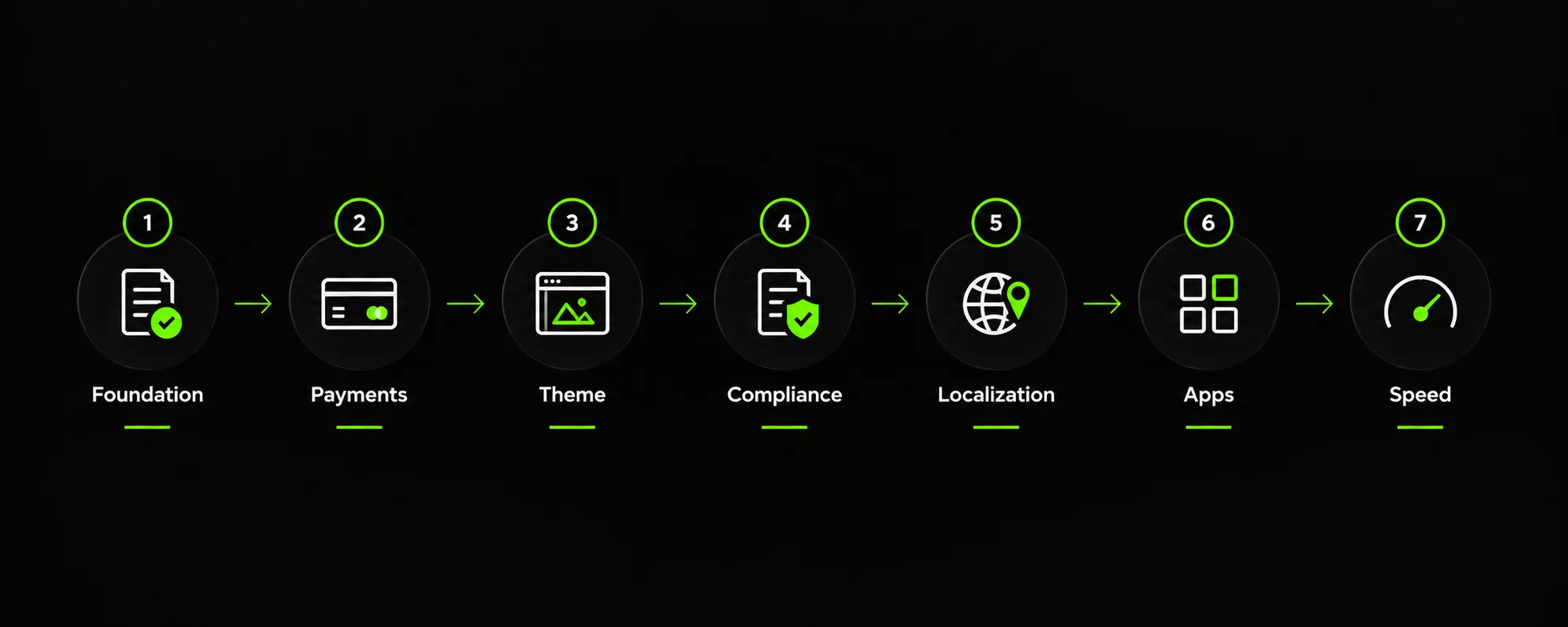
Step 1: Store Foundation and UAE Business Setup
Before configuring your Shopify store, make sure the underlying UAE business setup is in place. Getting these fundamentals right early helps prevent payment, tax, and reporting issues once orders start flowing.
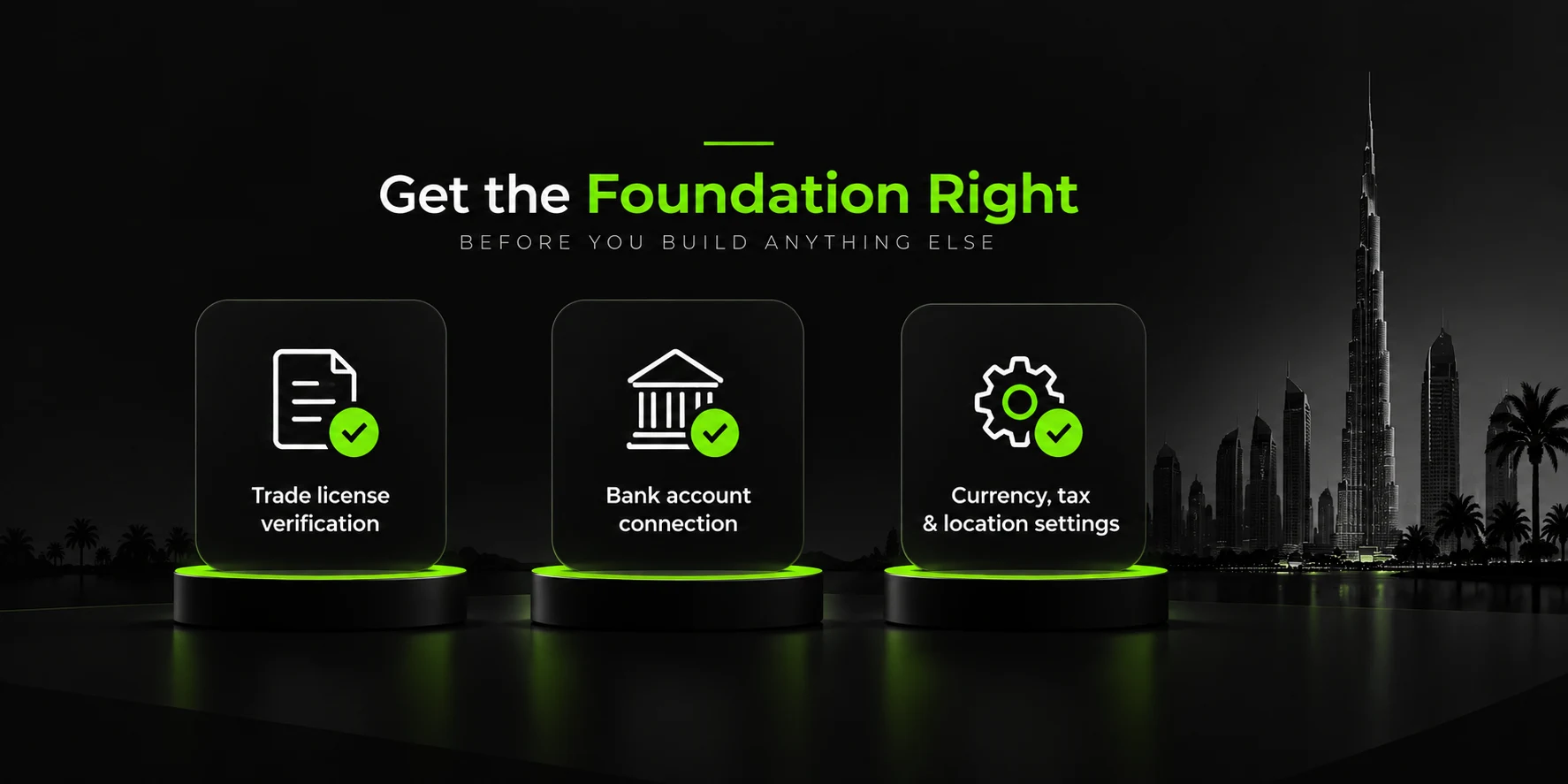
Trade License and Mainland vs. Free Zone
Confirm that your UAE trade license covers ecommerce and the sale of cosmetics or beauty products. Your choice between mainland and free zone should reflect where and how you plan to sell.
Free zone structures can work well for international and cross border operations, while businesses selling directly to UAE mainland customers should confirm that their licensing structure permits those activities. Licensing costs vary significantly by emirate, business activity, and free zone, so verify current fees before budgeting.
Connect a UAE Business Bank Account
Open a UAE business bank account before setting up your payment gateway. The settlement account should match the legal business name and trade license details.
Using a personal account or mismatched company information can create verification and settlement delays.
Set Currency, Tax Region, and Store Location
Set AED as the store currency, configure the tax region for the UAE, and enter the correct registered business location.
These settings can affect VAT calculations, shipping configuration, invoices, and reporting, so they should be reviewed before accepting your first order.
A clean foundation also makes the development and integration process smoother. For a broader guide to selecting the right technical partner, see our guide on how to choose an ecommerce development partner.
Step 2: UAE Payment Gateway Setup For Beauty Brands
This is where more UAE beauty brands lose conversion than any other single setup mistake.
mada Integration: Why It's Non-Negotiable
mada is the UAE's national payment scheme, and a meaningful share of UAE cardholders carry a mada card as their primary or only card.
A checkout that cannot accept mada is invisible to a real portion of your addressable market, and this gets missed constantly by brands that set up a generic international payment stack and assume it covers UAE customers by default.
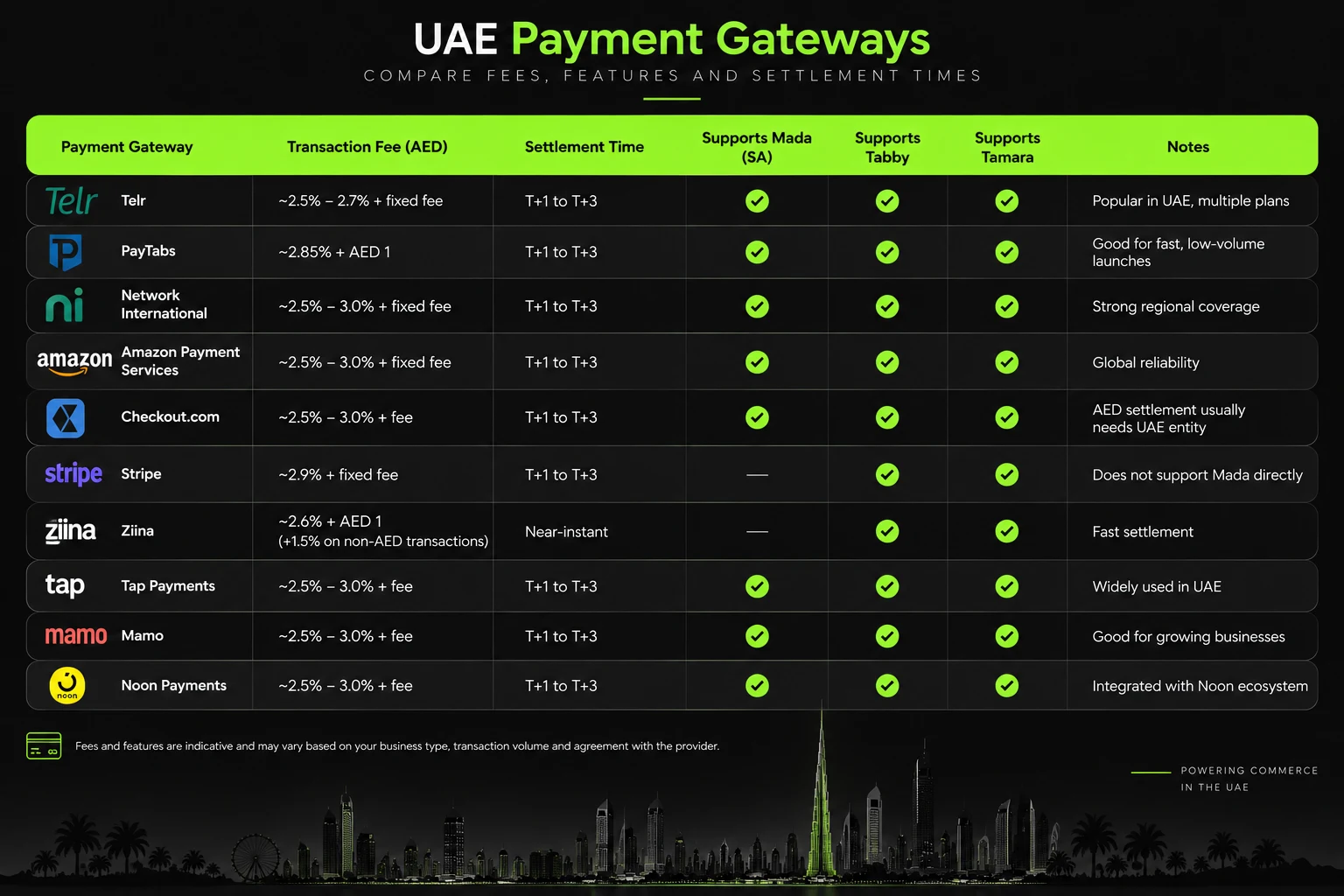
Network International Vs. Telr Vs. PayTabs
Shopify Payments is not available in the UAE, so mada and broader UAE card support come through a third-party gateway.
Network International, Telr, and PayTabs are the most commonly used options, each requiring a proper integration rather than a simple one-click app install in many cases; a gateway like Telr, for example, typically needs a custom-built connection to Shopify's checkout rather than an off-the-shelf App Store download, which is worth budgeting time for rather than assuming it is a same-day setup.
Apple Pay And Google Pay Setup
Mobile accounts for the large majority of UAE ecommerce traffic, and Apple Pay and Google Pay remove checkout friction specifically for mobile shoppers who do not want to manually enter card details on a small screen. Configure both alongside your primary gateway rather than treating them as optional extras.
Cash On Delivery Configuration
COD still matters meaningfully for UAE beauty D2C, particularly for first-time customers who have not yet built trust with a new brand. Configure COD as a genuine checkout option with clear delivery-window communication, not a grudging fallback, since a poorly configured COD flow creates more support tickets than it needs to.
Step 3: Choosing Your Shopify Theme
Theme selection matters for beauty brands because product pages need to handle shade swatches, ingredient information, product variants, high quality imagery, and image zoom effectively. A theme with a weak product page structure can lead to additional custom development and a less effective shopping experience.
The right theme should also support the brand’s mobile experience, Arabic RTL layout, product filtering, reviews, and merchandising requirements without relying on excessive apps or custom code. This is especially important for UAE beauty stores, where customers may browse and purchase primarily on mobile.
We have covered the leading Shopify themes for beauty brands in the UAE and Gulf in our detailed Best Shopify Templates for Beauty Products 2026 Guide, including theme specific comparisons of beauty features, product page capabilities, shade swatches, and image galleries.
This Suplex guide focuses on the wider Shopify setup, including payments, compliance, localization, and apps, so the theme selection process does not need to be repeated here.
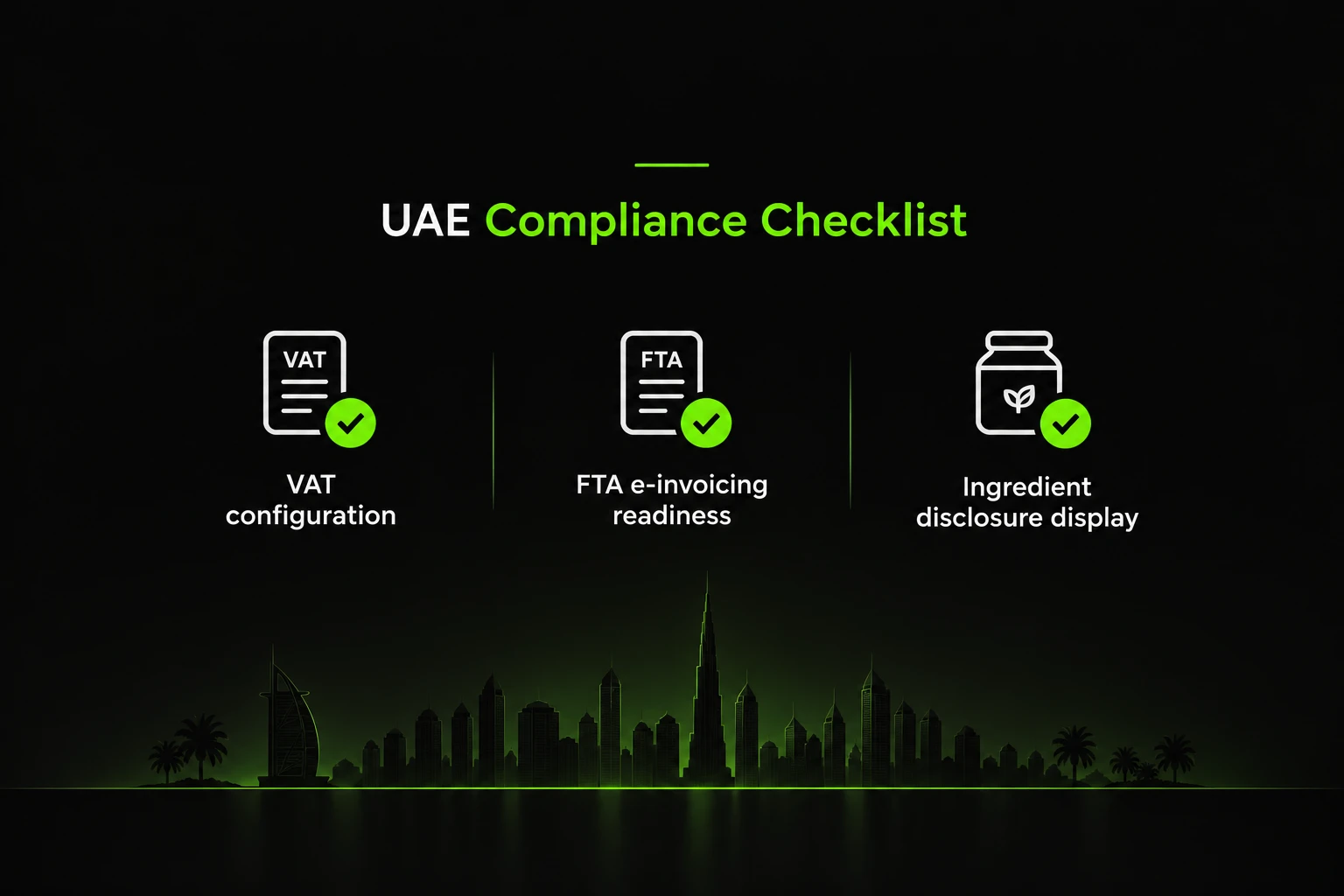
Step 4: VAT, FTA E-Invoicing and Compliance on Shopify
UAE beauty brands need to address tax and product compliance before launch, rather than treating them as post launch fixes.
Configuring UAE VAT in Shopify
The UAE standard VAT rate is 5%. VAT registration becomes mandatory when taxable supplies and imports exceed AED 375,000 over the relevant period, while voluntary registration is available above AED 187,500.
Once registered, configure Shopify’s tax settings correctly and ensure your business details, TRN, product pricing, invoices, and accounting records are consistent.
If the business imports services such as software or advertising, its accountant should also assess whether the reverse charge applies.
UAE E-Invoicing Requirements
The UAE is introducing e-invoicing through a phased rollout. The pilot began in July 2026, while mandatory implementation is scheduled based on annual revenue.
Businesses with revenue below AED 50 million are currently scheduled to implement from 1 July 2027. B2C transactions are currently excluded until further notice.
This does not mean Shopify invoices can simply be treated as compliant e-invoices. An e-invoice must use the required structured format and connect through an Accredited Service Provider when the business falls within the mandatory scope.
Cosmetic Product Compliance
Product compliance sits alongside the Shopify build. Cosmetics, personal care products, and fragrances may require registration through Dubai Municipality’s Montaji system, while products making certain therapeutic claims may fall under different regulatory requirements.
Product ingredients, claims, packaging, labels, and supporting documentation should therefore be reviewed before the catalogue goes live.
Step 5: Arabic Localization and RTL Design for Beauty Product Pages
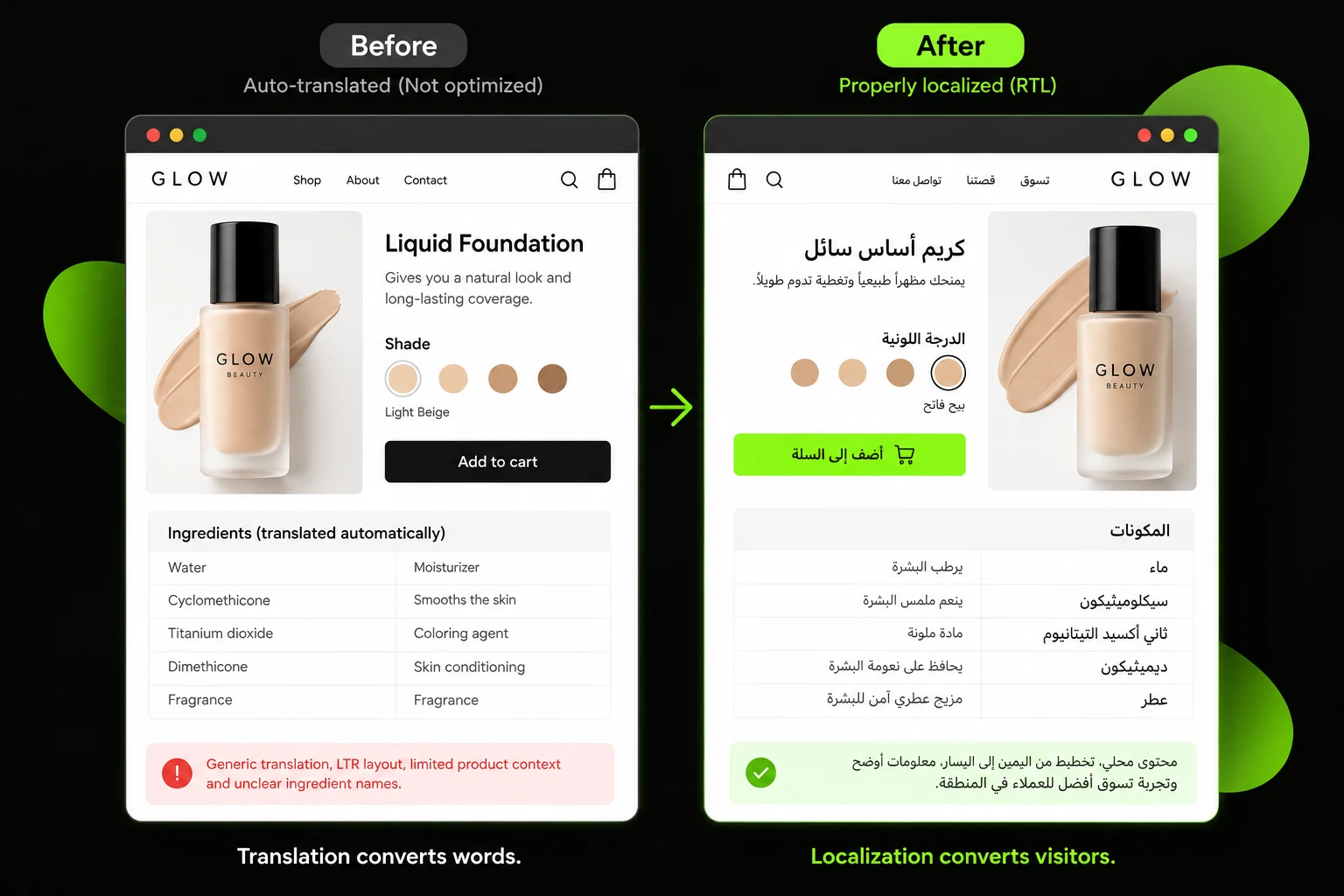
For UAE beauty brands, Arabic localization needs to go beyond translating English content. Shoppers often switch between Arabic and English, while beauty terminology around shades, skin types, finishes, ingredients and product benefits may not translate naturally.
Bilingual content should therefore be localized for the market, not simply generated through machine translation.
RTL Layout Issues Specific to Beauty Ecommerce
Arabic RTL design should mirror the complete shopping experience, including navigation, product grids, buttons, cart, and checkout. Beauty stores need particular attention to:
- Shade Selectors: Swatches and shade ordering should work naturally in both directions.
- Ingredient Tables: Columns, headings, alignment, and information hierarchy should mirror correctly.
- Product Galleries: Image navigation, captions, and before and after comparisons should behave correctly in RTL.
- Size and Shade Terminology: Measurements and beauty terminology should follow conventions familiar to Arabic speaking shoppers.
- Checkout: Form fields, validation messages, and navigation should be tested in Arabic rather than assuming the translated interface works correctly.
Arabic SEO for Beauty Product Pages
Arabic SEO also requires dedicated keyword research. Product titles, collection pages, H1s, meta descriptions, and category terms should reflect how UAE shoppers actually search rather than translating English keywords word for word.
For a deeper look at Arabic ecommerce design and Middle East localization, explore our international ecommerce setup guide. This approach helps create a Shopify beauty store that feels locally relevant in both languages while supporting a consistent customer experience.
Step 6: Essential Apps for a UAE Beauty Shopify Store
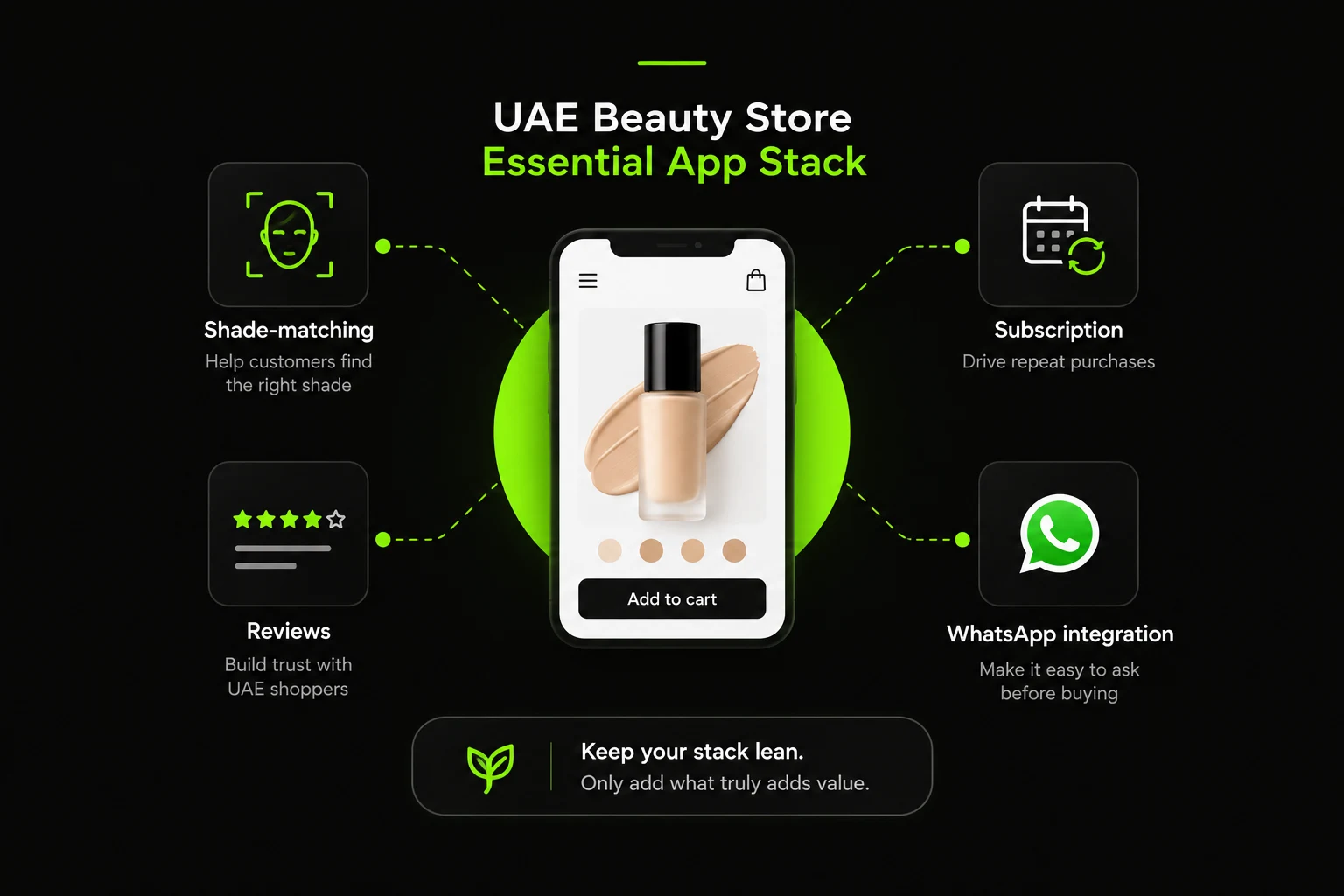
A UAE beauty store needs a focused app stack built around trust, product discovery, repeat purchases, and customer support. Installing too many apps can increase costs and affect store performance, so each app should solve a clear business need.
Shade Matching and Quiz Apps
Shade and skin type quizzes can reduce purchase uncertainty for products such as foundation, concealer, and skincare.
They help customers choose products based on their skin type, concerns, or shade instead of relying entirely on guesswork.
Subscription and Replenishment Apps
Skincare and haircare products often have natural replenishment cycles. Subscription apps can encourage repeat purchases through subscribe and save options, prepaid plans, or scheduled reorders.
Choose a solution based on your product cycle and expected order volume rather than adding subscriptions to every product.
Reviews and UGC Apps
Reviews, customer photos, and user generated content are particularly valuable for beauty products that customers cannot physically test online.
Where possible, collect reviews that include relevant context such as skin type, shade, product concern, or usage experience.
WhatsApp Integration
WhatsApp can support product consultations, order updates, customer service, and post purchase communication. For beauty brands, it can also provide a convenient channel for shade recommendations or skincare questions.
The goal is a lean, well integrated app stack rather than a long list of plugins. For ideas on using automation and AI within Shopify, explore our AI for Shopify guide.
Step 7: Mobile Optimization and Page Speed for Beauty Product Pages
Beauty stores are particularly image heavy, with high resolution product photography, shade swatches, before and after galleries, videos and zoom functionality all adding page weight.
Without careful optimization, this can slow the shopping experience, especially on mobile.
Page Speed Priorities
Compress product images and use modern formats such as WebP where appropriate. Lazy load below the fold images, minimize unnecessary third party app scripts, use Shopify’s content delivery infrastructure and test Core Web Vitals on mobile devices rather than relying only on desktop performance.
Mobile Checkout Best Practices
The entire shopping journey should be designed mobile first. Use clear product layouts, prominent add to cart buttons, simple navigation, guest checkout where appropriate, and fast payment options such as Apple Pay and Google Pay.
Test the complete checkout flow across common mobile devices and payment methods before launch.
For a deeper look at improving mobile ecommerce performance and usability, see our ecommerce mobile optimization best practices guide.
How We Approach Shopify Builds for Beauty Brands in the UAE
At Suplex, we approach Shopify builds for UAE beauty brands in a specific sequence, addressing the foundations before moving into design and merchandising.
This helps reduce costly post launch changes and ensures the store is built around the brand’s actual operational requirements.
Our typical process covers:
- Business and Payments First: We review the business setup, payment requirements, settlement process, and UAE specific considerations before development begins.
- Compliance Before Merchandising: VAT, invoicing, product documentation, and relevant compliance requirements are addressed before the catalogue is fully built.
- Localization Before Apps: Arabic RTL, bilingual content, navigation, and customer experience are established before adding third party functionality.
- Beauty Focused UX: Product pages are structured around ingredients, shades, variants, reviews, product imagery, and other information customers need to make a purchase decision.
- Performance Alongside Design: High resolution imagery, videos, shade selectors, and apps can add significant page weight, so we optimize the theme, media, and app stack together for mobile performance.
- Testing Before Launch: We test mobile layouts, Arabic RTL, checkout, payments, VAT calculations, product variants, and key customer journeys before the store goes live.
If you are planning a Shopify store for a UAE beauty brand, explore our Shopify and ecommerce services or our ecommerce store setup service to see how we can structure the build around your requirements.
Shopify UAE Beauty Store Launch Checklist
Use this checklist in sequence. Completing the foundational, payment, and compliance steps first helps avoid expensive changes after launch.
Foundation
☐ UAE trade license confirmed for ecommerce or cosmetics activities
☐ UAE business bank account opened and payment settlement details ready
☐ Shopify store configured with AED as the default currency
☐ UAE tax region and business location configured correctly
Payments
☐ Payment gateway selected and approved
☐ Required regional payment methods configured, including Mada where selling to Saudi Arabia
☐ Apple Pay and Google Pay enabled where supported
☐ Cash on delivery configured with appropriate order limits
☐ Test transaction, refund, and settlement process completed
Compliance
☐ VAT registration completed where applicable
☐ 5% UAE VAT configured correctly with the business TRN
☐ E-invoicing requirements reviewed and relevant integration planned
☐ Cosmetic product registration and documentation confirmed where required
☐ Ingredient disclosure and product labeling reviewed
Localization
☐ Arabic and English storefront experience configured
☐ RTL layout tested across desktop and mobile
☐ Shade selectors, ingredient tables, galleries, and checkout tested in RTL
☐ Arabic product copy and metadata professionally localized
☐ Arabic keyword research completed for key products and collections
Apps
☐ Shade matching or product quiz configured where relevant
☐ Subscription or replenishment functionality tested where appropriate
☐ Reviews and UGC functionality configured
☐ WhatsApp integration set up for customer support and consultations
☐ Unnecessary apps and scripts removed
Performance
☐ Product images compressed and optimized
☐ Third party scripts reviewed and minimized
☐ Mobile Core Web Vitals tested
☐ Checkout tested end to end on iOS and Android
☐ Payment, VAT, discounts, shipping, and order confirmation tested before launch
Frequently Asked Questions
Is Shopify legal and fully supported for ecommerce businesses in the UAE?
Yes. Shopify is widely used by UAE ecommerce businesses and supports UAE-based payment gateways, AED currency, and VAT configuration. You'll still need a valid UAE trade license for the underlying business and must configure tax, invoicing, and payment settings correctly. Shopify itself doesn't handle UAE-specific compliance automatically out of the box.
Does Shopify support mada, the UAE's national payment scheme, natively?
Not directly through Shopify Payments, since Shopify Payments isn't available in the UAE. You'll need a third-party gateway like Network International, Telr, or PayTabs that supports mada, then connect it through Shopify's payment provider integrations. This is one of the most common setup mistakes UAE brands make.
What's the best Shopify plan for a small UAE beauty brand just starting out?
Standard Shopify (Basic or Shopify plan tier) is sufficient for most beauty brands launching in the UAE. Shopify Plus only becomes worthwhile once you're managing multiple storefronts, heavy B2B/wholesale volume, or AED 3M-plus in annual GMV, most new beauty brands don't need that complexity or cost on day one.
Do I need a separate Arabic website, or can I use Shopify's translation apps?
You don't need a fully separate site. Shopify Markets and translation apps like Weglot or Shopify's native Translate & Adapt can run bilingual storefronts on one store. But auto-translation alone isn't enough for beauty products; RTL layout, localized sizing/shade terminology, and Arabic SEO need manual review, not just machine translation.
How long does it take to set up a Shopify store for a beauty brand in the UAE?
A properly sequenced setup, platform, payments, compliance, localization, and apps, typically takes four to six weeks for a beauty brand with a moderate catalog size of 50 to 300 SKUs. Rushing the payment gateway or VAT configuration to launch faster is the most common cause of post-launch fixes.
What apps do most successful UAE beauty brands use on Shopify?
Common patterns include a shade/skin-match quiz app, a subscription app for replenishment, a reviews/UGC app for trust-building, and WhatsApp integration for order updates, since WhatsApp is a dominant customer communication channel in the UAE. Stack size should stay lean; each added app affects page speed.
Hi, I’m Rishabh Jain
I believe great design has the power to shape perception, build trust, and move businesses forward. That belief is what led me to found Suplex Design Studio, a global branding and packaging studio working with FMCG and D2C brands across markets.I started suplex at 25 with a clear intent, to create design that is strategic, thoughtful, and commercially meaningful. By 28, the studio had scaled globally, guided by a strong foundation in Integrated Design that I developed during my academic journey in London, where I was honoured with the Dean’s Award.
Over the years, I’ve had the opportunity to work with 100+ brands, from Fortune 500 organizations to family-run businesses, helping them build packaging and brand systems that create recall, relevance, and long-term value.
Suplex’s work has been recognized internationally, including the Manifest Award (2024), the Clutch Global Award (2025), and features on platforms such as Packaging of the World, The Dieline, and the World Brand Design Society.
None of this would be possible without the people behind the work. I’m deeply grateful to the suplex team, whose commitment, creativity, and attention to detail turn ideas into meaningful brand experiences every day.
At the heart of my work is a simple philosophy, design should be intentional, honest, and built to last, and that continues to guide everything we create at suplex.















Let’s Make It Happen
E-Commerce Success Stories
%201.avif)






.avif)
.avif)
Build Your D2C Business The Right Way
Build It With Suplex.


