Best Strategies for Improving Ecommerce Conversion Rates in the UAE (2027 Guide)


Best Strategies for Improving Ecommerce Conversion Rates in the UAE (2027 Guide)
The best strategies for improving ecommerce conversion rates in the UAE differ from global CRO advice.
Global playbooks assume card-first payments, street addresses, one language and no dominant marketplaces. None of that holds here.
This Suplex blog gives 12 strategies for D2C and FMCG brands selling in the UAE, ordered so you fix the biggest problems first.
Why Ecommerce Conversion Works Differently in the UAE
UAE shoppers have high expectations for delivery, payment convenience and pricing. Mobile shopping is widespread, marketplaces set a strong benchmark and many customers compare offers before placing an order. These factors affect how ecommerce brands should approach conversion rate optimization.
Mobile Shopping Dominates, But Reported Figures Vary: Udora and Admitad put mobile at 53% of online purchases in the first half of 2026, while Mordor Intelligence estimates mobile accounted for 78.67% of ecommerce transactions in 2025. The figures use different methodologies, so your own Shopify analytics is the best guide to your customers' behaviour.
Digital Payments Are Mainstream: Visa reports that online and in-app payments increased from 35% of UAE domestic payment volume in 2019 to 55% in 2026. Cards and digital wallets are important options, but cash on delivery (COD) still matters to some first-time buyers and customers outside Dubai.
Delivery Expectations Are High: DHL's 2026 research found that 92% of UAE shoppers prioritise fast, free delivery and easy returns. Display realistic delivery estimates and return terms before checkout.
Customers Have Different Language Preferences: Around 85% of UAE residents are expatriates. English and Arabic experiences can both matter, depending on your audience. Use clear translations and a properly designed Arabic right-to-left (RTL) layout where appropriate.
Marketplaces Set Customer Expectations: Noon and Amazon.ae influence what shoppers expect from delivery, returns and pricing. Your store needs clear reasons to buy directly from your brand.
Discounts Influence Purchasing Decisions: Udora and Admitad report that more than half of online transactions used a coupon or promotional code, while the average discounted order value rose from $89 to $122. Make offers worthwhile, but avoid relying on constant discounts to generate sales.
What Is a Good Conversion Rate for a UAE Store?
There is no reliable, widely accepted public benchmark specific to the UAE. Global category averages can provide context, but your own historical performance is a better starting point. Suplex’s Shopify conversion rate optimization guide explains how to compare conversion rates by category and device.
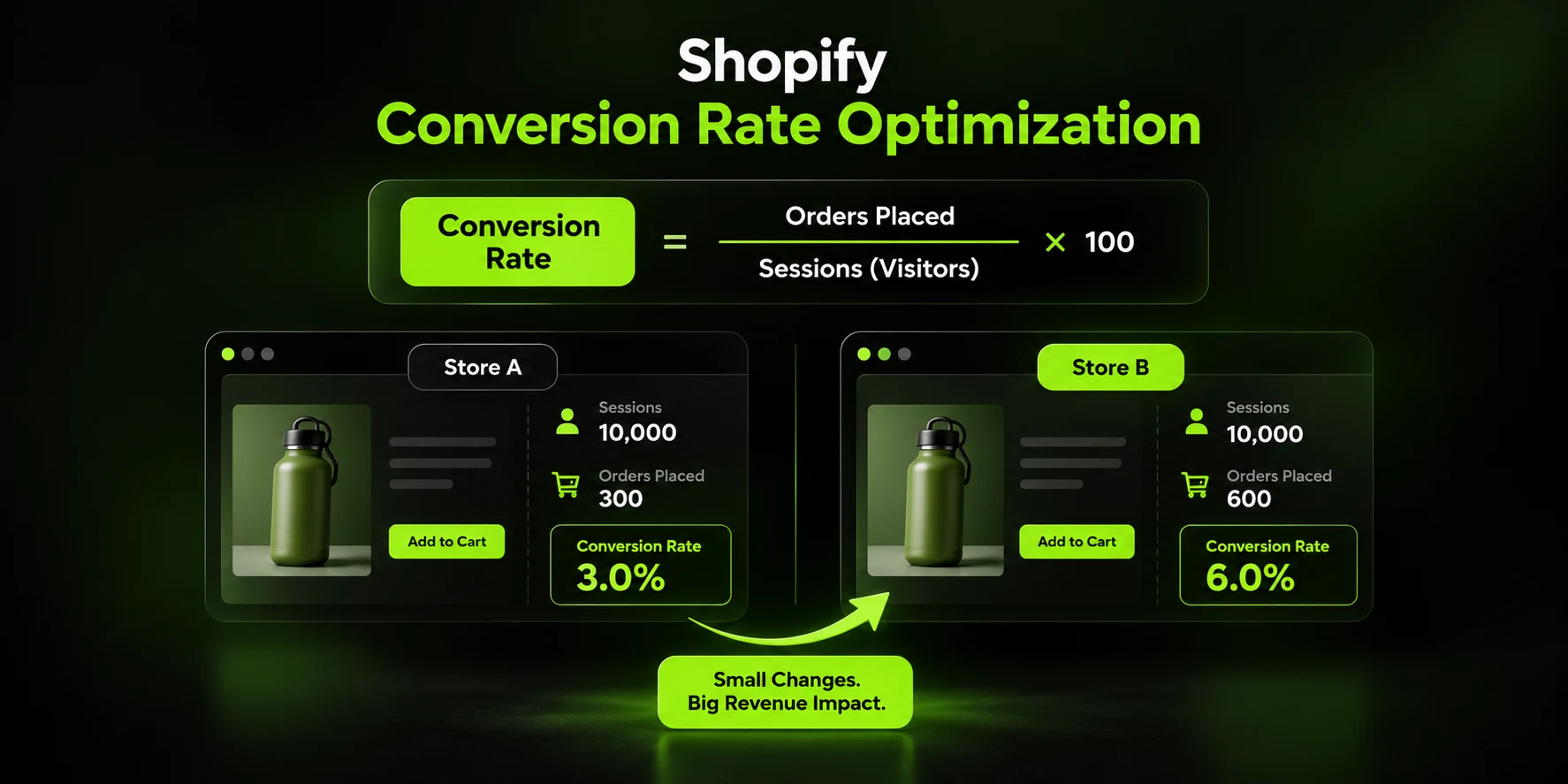
For COD-heavy stores, track delivered-order conversion alongside placed-order conversion. The difference can reveal whether apparent growth is translating into successful deliveries.
In this illustrative example, Store A generates more orders but loses a larger share to return to origin (RTO). Store B converts fewer sessions into placed orders but more into delivered orders.
Tracking both metrics gives you a clearer picture of store performance, particularly when COD represents a significant share of sales.
Payments and Cost Clarity
Payment options and unexpected charges can determine whether a UAE shopper completes an order. The goal is to make preferred payment methods easy to find and show the full cost before checkout.
Strategy 1: Build the Payment Stack UAE Shoppers Expect
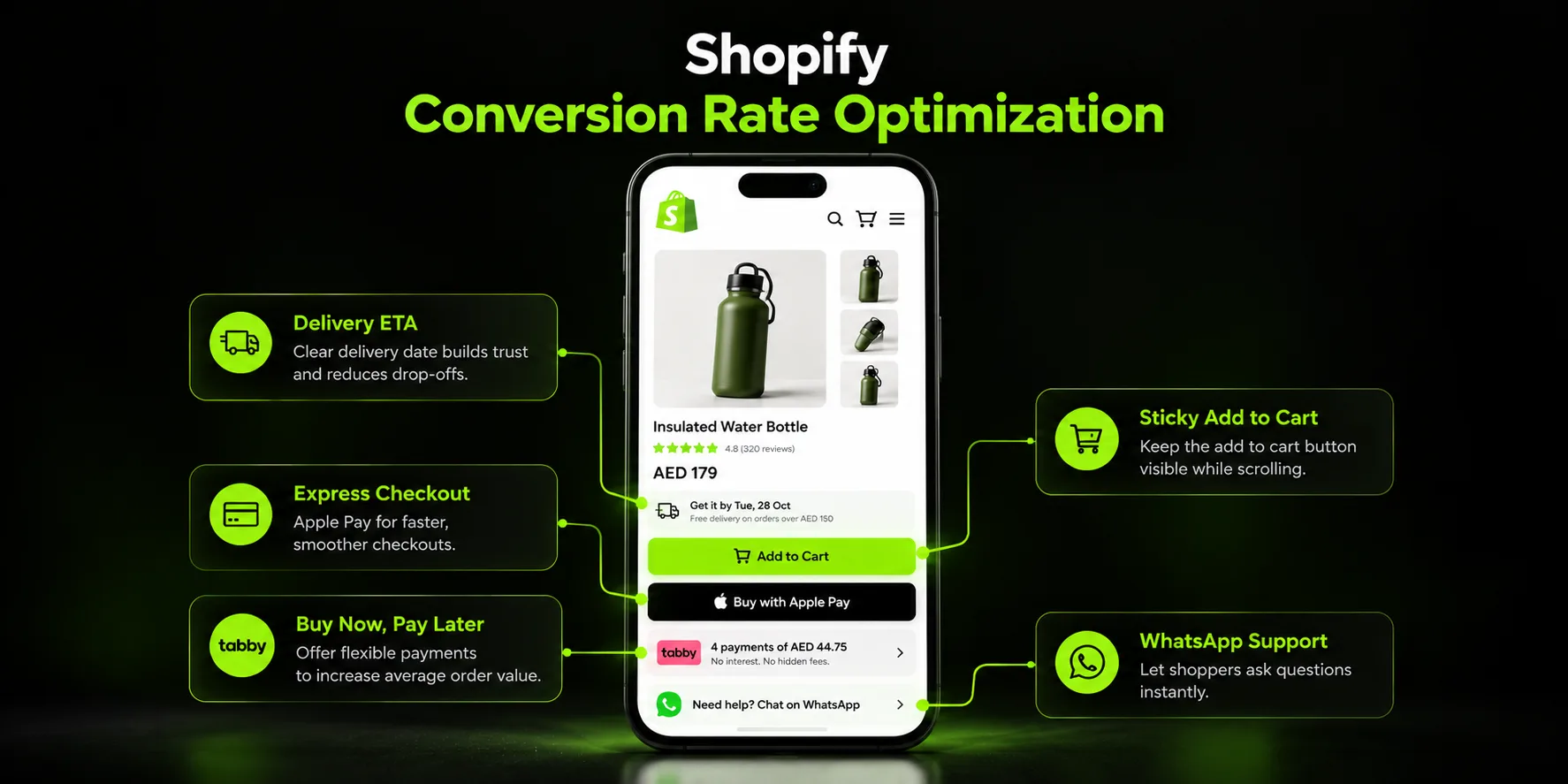
Offer the payment methods your customers actually use: cards, Apple Pay, Google Pay, BNPL through Tabby and Tamara, and cash on delivery (COD) where it suits your products and audience.
Arrange checkout options with mobile shoppers in mind. Make digital wallets easy to access, keep card payments straightforward, and show BNPL options near the product price rather than introducing them for the first time at checkout.
Example: displaying "4 payments of AED 75" helps shoppers understand the available payment plan before deciding to buy.
Payment availability depends on your gateway and Shopify setup, so confirm which methods you can support in the UAE.
Tabby advertises an 18% conversion lift and a 33% increase in average order value; these are vendor claims, not guaranteed results for every store.
When choosing a provider, compare transaction fees, settlement terms, supported payment methods and integration requirements. Suplex guide to choosing a payment gateway for UAE ecommerce covers the factors worth considering.
Strategy 2: Keep COD Without Letting RTO Eat the Gains
COD remains useful for shoppers who prefer paying on delivery, particularly first-time customers and buyers who are unfamiliar with a brand.
The downside is return to origin (RTO): when a parcel is refused or cannot be delivered, the merchant may lose the sale and incur delivery and return costs.
To reduce these losses:
- Confirm orders through OTP or WhatsApp before dispatch.
- Test partial prepayment for higher-value orders.
- Set sensible COD limits for high-risk products or orders.
- Review repeat refusals and apply appropriate controls.
- Test a small incentive for customers who switch to prepaid payment.
Quiqup, a UAE courier, cites an RTO rate below 10% as a realistic goal for stores combining COD and prepaid orders.
Treat this as a reference point, not a universal benchmark. Track RTO by courier, emirate, product category and customer type to identify where the losses occur.
Strategy 3: Show the Full AED Cost Before Checkout
Display prices inclusive of the applicable 5% VAT, and make delivery charges, COD fees and free-delivery thresholds clear on product pages and in the cart.
If a shopper sees one price on the product page and discovers additional charges at checkout, they may abandon the order even when the final amount is affordable.
Showing the full cost earlier gives customers a clearer basis for deciding whether to buy and reduces unpleasant surprises at the final step.
Delivery and Address Experience
For UAE shoppers, delivery speed, clear arrival dates and a straightforward checkout all influence the decision to buy. Address errors can also lead to failed deliveries, extra costs and frustrated customers.
Strategy 4: Show Delivery Estimates Before Checkout
Display delivery information on the product page, where shoppers can see it before adding an item to their cart. For example, "Order in the next 3 hours for same-day delivery in Dubai" gives customers a clear expectation, provided the cutoff time and delivery promise are accurate.
Set delivery estimates by emirate rather than applying one promise across the UAE. Explain any conditions that affect same-day or next-day delivery, and make the returns policy easy to find. Clear information helps shoppers decide whether the product will arrive when they need it.
Strategy 5: Make Address Entry Easier for UAE Deliveries
UAE addresses often rely on building names, villa numbers, areas and landmarks rather than conventional street addresses and postcodes. A checkout form designed around another country's address system can create unnecessary friction.
Keep address fields relevant to local deliveries. Depending on your courier's requirements, collect:
- Emirate and area
- Building name, building number or villa number
- Street or landmark details
- A map pin, where supported
- A working contact number
Avoid making a postcode mandatory when it is not required by your delivery provider. Support Arabic input where your checkout and courier integration allow it, and test the full process to ensure address details reach the courier correctly.
These changes can make checkout easier while reducing delivery errors. The important part is to match the form to your courier's actual requirements rather than adding fields customers cannot reliably complete.

Language and Trust
For first-time shoppers, the decision to buy often comes down to two questions: can I understand this store, and can I trust it to deliver what I ordered? Language, business details and customer support all help answer those questions.
Strategy 6: Build a Complete Arabic Experience
Check your Arabic-language sessions, search queries and WhatsApp conversations before deciding whether to launch an Arabic storefront. If demand is limited, a well-maintained English store may be the better starting point.
If you introduce Arabic, make sure the entire shopping journey supports it. This includes right-to-left (RTL) layouts, translated error messages, order confirmations, return policies and correctly displayed prices and numbers. A homepage in Arabic followed by an English-only checkout creates an inconsistent experience and can undermine customer confidence.
English remains useful for many UAE audiences, while Arabic can be particularly important when targeting Emirati and wider Arab customers or expanding into Saudi Arabia.
Translation alone isn't enough; navigation, page layouts and checkout need to work naturally in both languages. This is especially important for Arabic ecommerce website design, where RTL layouts affect how customers move through the store.
Strategy 7: Make Your Business Easy to Verify
Shoppers who have never bought from your brand need reasons to feel comfortable placing an order. Make essential business information easy to find rather than expecting customers to search for it.
Focus on these trust signals:
- Business Details: Display your company name, relevant trade licence information and business address where appropriate.
- Accessible Support: Provide a WhatsApp number or another support channel that customers can actually reach.
- Clear Policies: Explain delivery, returns, refunds and exchanges in straightforward language.
- Customer Reviews: Show genuine reviews and, where relevant, feedback from Arabic-speaking customers.
- Brand Credibility: Share your founder story, relevant media coverage or delivery partnerships when these are available and verifiable.
These details matter most when a shopper is deciding whether to place their first order. Make it easy to find out who runs the business, how to get help and what happens if something goes wrong.
Clear policies, consistent design and real customer feedback can do more to build confidence than a row of generic trust badges. Those are also practical elements of trust-focused ecommerce website design.
Competing on Value
UAE shoppers can discover a product on social media, compare it on Noon or Amazon.ae, and buy wherever the offer makes the most sense.
Your D2C store needs a clear reason to win that sale beyond simply being another place to buy the same product.
Strategy 8: Give Shoppers a Reason to Buy Direct
If customers can get the same product for less on a marketplace, with similar delivery and returns, your own store has little advantage.
Give them something worth buying directly, exclusive bundles, loyalty rewards, better product information, personalised gifting or a brand warranty. If you charge more than marketplace listings, make the added value clear before customers reach checkout.
Your product page also needs to answer questions a marketplace listing might leave open. Include useful product details, clear delivery and return information, comparison images and genuine customer reviews. The goal is to make buying direct feel like a sensible choice, not an extra step.
The right balance depends on your channel strategy, margins and customer relationships. Choosing between a marketplace and your own ecommerce site can help clarify what each channel should do for your business.
Strategy 9: Make Discounts Easy to Use Without Relying on Them
A coupon field can send shoppers away from checkout to look for a discount code, particularly when they suspect an offer is available but cannot find it.
Keep current promotions easy to use. Apply eligible discounts automatically where possible, and avoid making the coupon box more prominent than the checkout itself.
Tiered offers, such as “Spend AED 300 and save AED 40,” can also encourage larger baskets without discounting every order.
The bigger question is whether promotions are bringing in profitable sales or simply reducing the amount customers pay for orders they would have placed anyway.
Track discount rate, average order value and margin per session alongside conversion rate. If conversion rises but margin per session falls, the promotion may be costing more than it delivers.
Use your store analytics to compare results by campaign and traffic source before extending an offer.
Channels, Experience and Timing
Conversion depends on more than the product page and checkout. UAE shoppers may need an answer before buying, browse on mobile, or shop at very different hours during Ramadan and major sale periods. Your store experience should account for all three.
Strategy 10: Use WhatsApp and AI Chat to Remove Buying Hesitation
For higher-priced products, a quick answer about sizing, authenticity or delivery can make the difference between an order and an abandoned session. Add a WhatsApp contact option to relevant product pages, where shoppers are likely to have questions.
The same channel can help after purchase. Order confirmations, delivery updates and rescheduling messages can reduce confusion and help prevent avoidable cash-on-delivery refusals.
For cart recovery, follow WhatsApp's opt-in and messaging rules rather than sending unsolicited reminders.
AI chat can handle routine questions, but it needs clear limits. DHL's 2026 survey found that 51% of UAE respondents used AI-powered chat tools while shopping online.
If you introduce an assistant, make sure it supports the languages your customers use and can transfer complaints, refund requests and complex issues to a person.
Strategy 11: Make Mobile Shopping Feel Effortless
Customers arriving from Instagram, TikTok or paid ads may be browsing on mobile data, so a store that works well on office Wi-Fi can still feel slow or awkward to them.
Prioritise a fast-loading product page, clear product information, a visible add-to-cart button and express payment options such as Apple Pay where supported. Keep forms short and test the full journey on real mobile devices, including the transition from product page to checkout.
These changes should be tested as one shopping journey, not as isolated design tweaks. Our guidance on mobile-first ecommerce design covers how to structure the experience around smaller screens, while Shopify speed optimisation looks at the technical issues that can slow it down.
Strategy 12: Time CRO Changes Around the UAE Retail Calendar
Ramadan and Eid, Dubai Shopping Festival, White Friday and November sales can all change traffic, purchase intent and customer expectations. Back-to-school periods and the summer slowdown can also affect demand, depending on the category.
Prepare campaign landing pages, promotional terms, inventory and delivery cutoffs before each major event. Avoid releasing untested checkout or theme changes just before a peak period; aim to finish high-risk updates and allow time for validation at least two to three weeks beforehand.
Shopping patterns can shift during Ramadan, including later browsing hours. Make sure customer support and WhatsApp coverage reflect the hours your audience is active.
For every major campaign, monitor conversion alongside average order value, margin and fulfilment performance. A sales spike is not necessarily a win if discounting eats into profit or delivery delays create more cancellations.
Confirm dates for upcoming retail events when planning, since Ramadan and Eid dates vary each year.
How to Prioritize These Strategies: The UAE Conversion Stack
Twelve strategies are too many to tackle at once. Use this stack to decide what to fix first, based on where your store is losing orders.
Work from the bottom of the customer journey backwards, starting with measurement. Without reliable data, it is difficult to tell whether a problem comes from checkout, delivery, traffic quality or something else.
Then address the biggest confirmed bottleneck. If COD orders are frequently returned, improve confirmation and delivery processes before investing heavily in Arabic content.
If shoppers abandon checkout after seeing the final cost, review payment options and fee transparency before launching another promotion.
Use the stack as a prioritisation guide, not a rigid sequence. Fix urgent problems wherever they appear, measure the impact, and move to the next constraint once the data shows progress.
How Suplex Helps UAE Brands Improve Ecommerce Conversion Rates
Based in Dubai, Suplex helps D2C and FMCG brands improve ecommerce performance across the UAE, GCC and international markets. Our team covers CRO research, UX design, Shopify and WordPress development, Arabic RTL design, payment integrations and ecommerce analytics.
Our work includes improving Tabby and Tamara integrations, COD confirmation flows, multi-currency experiences and delivered-order tracking.
Through D2C data analytics service, we help brands connect storefront performance with what happens after an order is placed. For businesses expanding across markets, our international ecommerce setup service helps address market-specific requirements.
When Should You Bring in an Agency?
Not every conversion issue needs outside help. Your internal team can often handle delivery messaging, coupon rules, address forms and WhatsApp contact options.
Specialist support makes more sense when you need to:
- Build an Arabic RTL shopping and checkout experience.
- Migrate platforms or expand into multiple markets.
- Connect COD confirmation flows with courier operations.
- Diagnose conversion problems that standard analytics cannot explain.
If you're unsure where the problem lies, a Shopify audit can help identify priorities before you commit to a larger project. If shoppers understand the product but don't see enough value in the offer, a redesign alone may not solve the problem.
See Our Work
Our Great Lakes and Miduty case studies showcase work categorised under Conversion Optimization. For a different challenge, our Tea Culture of the World case study explores increasing average order value.
Our approach is straightforward: identify the constraint, recommend changes that address it, and measure the result. Sometimes that means a larger project; sometimes, a few targeted fixes are enough.
Frequently Asked Questions About Ecommerce Conversion Rates in the UAE
What Is a Good Ecommerce Conversion Rate in the UAE?
There is no reliable public benchmark specific to the UAE. A global rate of around 2% to 3% is a rough starting point, but results vary by category, device and traffic source. Compare your store against its own 90-day baseline. If you offer COD, track delivered orders per session alongside placed-order conversion to account for failed deliveries.
Does Offering Cash on Delivery Increase Conversion in the UAE?
COD can help convert first-time buyers who are reluctant to pay online, but it also carries a risk of refused or failed deliveries. Offer WhatsApp or OTP confirmation, consider partial prepayment for high-value orders, and monitor RTO by courier and emirate. Aim to reduce RTO based on your own baseline rather than treating 10% as a universal benchmark.
Should My UAE Online Store Have an Arabic Version?
Start by checking Arabic-language sessions, search queries and customer support messages. If demand justifies it, build a complete Arabic experience with right-to-left layouts, translated checkout messages, policies and order confirmations. A partially translated store can create confusion and undermine trust.
Do Tabby and Tamara Increase Ecommerce Conversion Rates?
BNPL providers report conversion and average order value (AOV) gains, but results vary by store and those figures may reflect vendor-reported claims. Display instalment options on product pages where relevant, then compare conversion, AOV, margins and COD share before and after launch to see whether BNPL benefits your business.
How Fast Does Delivery Need to Be for UAE Shoppers?
Predictable delivery matters as much as speed. Show estimated delivery dates by emirate, order cutoffs, shipping fees and return terms on product pages. Offer same-day or next-day delivery where your operations can support it, rather than promising speeds you cannot consistently meet.
How Can a D2C Brand Compete With Noon and Amazon on Conversion?
Give shoppers a clear reason to buy direct, such as exclusive bundles, loyalty rewards, gifting options, a brand warranty or more detailed product information. Your product pages should answer questions that marketplace listings leave unresolved. If you charge more, explain what customers get in return.
How Long Does It Take to Improve Ecommerce Conversion Rates?
Straightforward changes to payment options, delivery messaging or checkout friction may show early results within two to four weeks. Larger changes, such as an Arabic checkout or a product page redesign, may need six to twelve weeks of data, depending on traffic volume. Avoid major untested releases just before Ramadan, White Friday or Dubai Shopping Festival.
Hi, I’m Rishabh Jain
I believe great digital experiences have the power to shape perception, build trust, and move businesses forward. That belief led me to found Suplex Design Studio, a global digital design and development studio helping FMCG and D2C brands build websites and digital experiences that are strategic, thoughtful, and commercially meaningful.
I started Suplex at 25 with a clear intent, to create digital experiences that look appealing, work seamlessly, and help D2C businesses grow. By 28, the studio had scaled globally, guided by a strong foundation in integrated design that I developed during my academic journey in London, where I was honoured with the Dean’s Award.
Over the years, I’ve had the opportunity to work with 100+ brands, from Fortune 500 organisations to family-run businesses, helping them build websites, e-commerce experiences, and digital products that create clarity, credibility, and long-term value.
Our work has been recognised internationally, including the Manifest Award (2024), the Clutch Global Award (2025), and features across platforms such as The Dieline, Packaging of the World, and the World Brand Design Society.
None of this would be possible without the people behind the work. I’m deeply grateful to the Suplex team, whose commitment, creativity, and attention to detail turn ideas into meaningful digital experiences every day.
At the heart of our work is a simple philosophy, digital design should be intentional, functional, and built to create real business value. That continues to guide everything we create at Suplex.



































Let’s Make It Happen
E-Commerce Success Stories









Build Your D2C Business The Right Way
Build It With Suplex.


