Ecommerce Website Development for Food Brands in the UAE: What the Build Has to Handle

Ecommerce Website Development for Food Brands in the UAE: What the Build Has to Handle
Ecommerce website development for food brands in the UAE requires more than a good-looking store. Food products expire, melt, and often need temperature-controlled storage or scheduled delivery.
Without the right setup, brands risk selling expired stock, charging incorrect delivery rates, and losing money on refused COD orders.
As a Dubai- based ecommerce agency, here's our guide to explaining the essential development requirements, including product data, shelf-life tracking, inventory management, delivery rules, payment flows and UAE compliance, to help food brands build a reliable online store.
What Makes Food Ecommerce Development Different
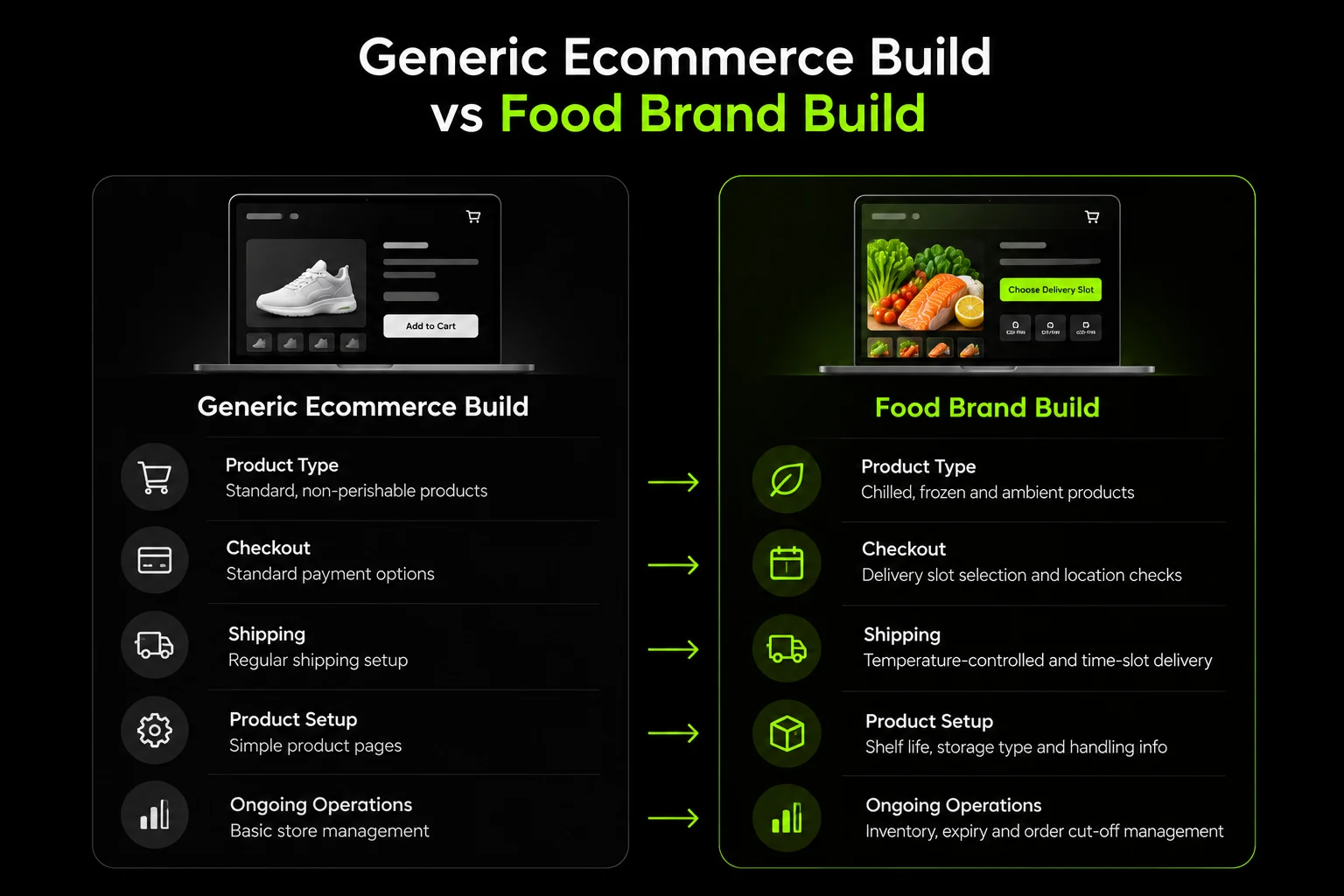
A standard ecommerce store treats stock as a number, shipping as a rate, and COD as another payment option.
Food ecommerce needs more careful planning because products have expiry dates, storage requirements, and delivery constraints.
These differences affect the data model, inventory management, checkout logic, delivery setup, and reporting. They also influence project scope and budget, so operational requirements should be settled before development begins.
A store may look ready for launch but still struggle with expired stock, unsuitable delivery conditions, or marketplace cancellations if these requirements are overlooked. The visual side matters as well.
Example: how product photography presents freshness, texture and packaging can influence buying decisions, particularly for food brands selling online. But those design choices need to work alongside the systems that keep orders accurate and deliveries reliable.
The Five Build Requirements Every UAE Food Store Needs
A food ecommerce store needs more than product pages and checkout. It must handle regulated product information, expiry dates, temperature-sensitive deliveries, repeat orders, and stock across multiple sales channels.
These requirements affect the platform, integrations, and development costs, so they should be planned before the build begins.
1. A Product Data Model for Regulated Information
Food products need structured information that standard product templates may not cover adequately. This includes ingredients, allergens, nutrition panels, halal certification, storage temperature, shelf life, country of origin, and registration references where applicable.
On Shopify, metafields can store this information; WooCommerce supports custom fields. Add Arabic equivalents wherever required and display product details as text rather than relying on label images.
Structured data is easier to update, improves accessibility, and allows customers to filter products by attributes such as vegan, gluten-free, and sugar-free.
How this information appears matters too. Clear layouts, readable product details and good packaging photography help customers make informed decisions, as discussed in our guide to D2C food and beverage website design.
2. Batch, Expiry, and FEFO Inventory
Shopify tracks stock quantities but does not natively provide complete batch and expiry management. Food brands may need an inventory app or an ERP or warehouse management system (WMS) integration.
FEFO means first expired, first out: stock with the earliest expiry date should be dispatched first.
Dubai Municipality's guideline DM-HSD-GU18-ECOM2 (Version 2, May 2024) covers warehousing practices such as temperature monitoring, expired products, stock rotation and traceability.
Its scope is health supplements and food-contact materials, so check which requirements apply to your product category.
A suitable inventory system can support near-expiry promotions, prevent expired stock from being sold, and identify customers affected by a product recall.
3. A Delivery Engine, Not Just a Shipping Rate
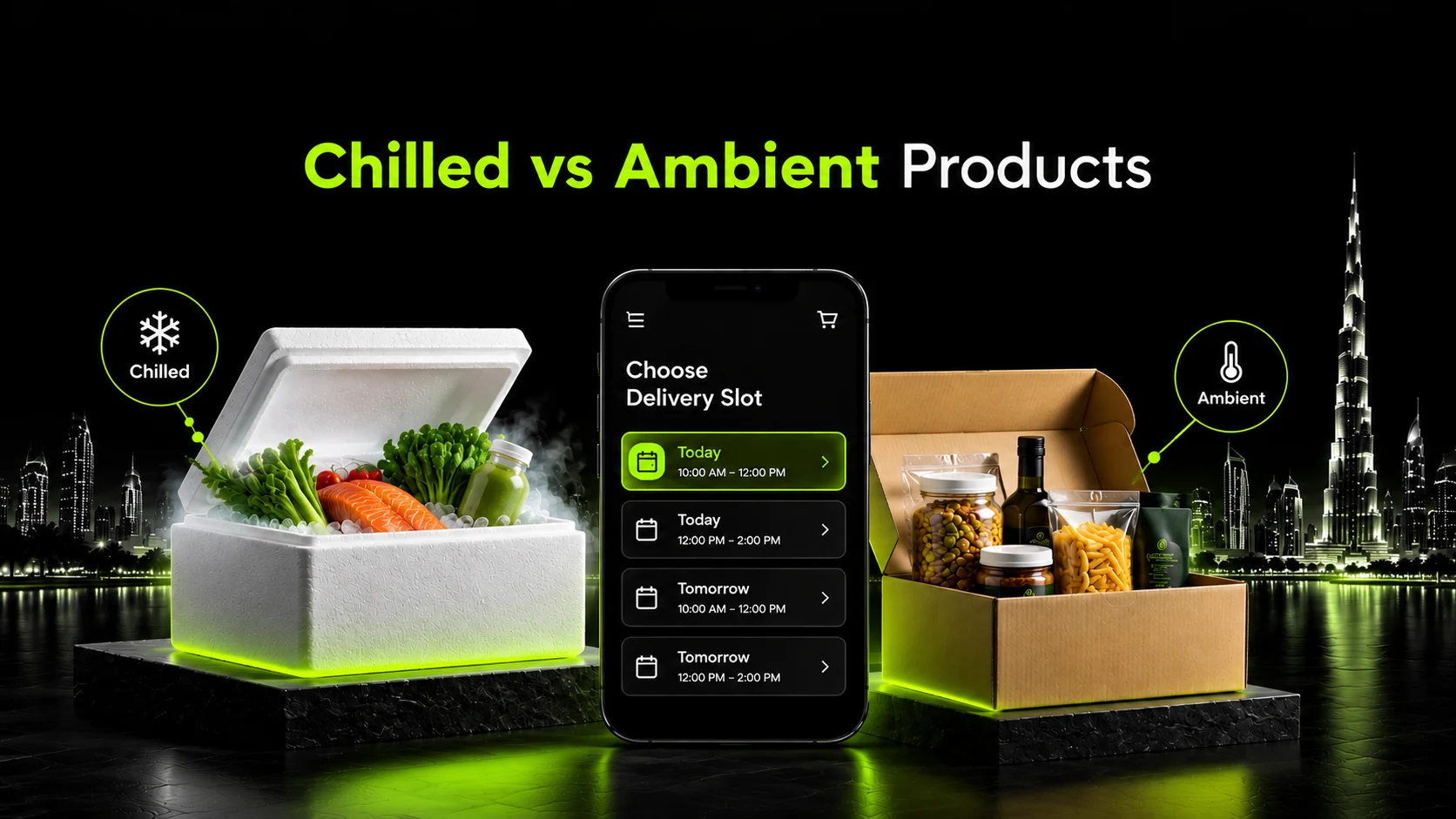
Food delivery depends on location, temperature, timing, and capacity. The store should support delivery zones by emirate and area, date and time-slot selection, order cut-offs, slot limits, and separate rules for chilled, frozen, and ambient products.
Mixed carts need special attention. If an order contains chilled and ambient items, decide whether to split the shipment or send everything in temperature-controlled packaging. The right approach depends on product requirements, courier capabilities, and cost.
UAE summers also require planning for heat-sensitive products. Insulated packaging, earlier cut-offs, and restricted delivery windows may be necessary. Clear delivery promises and charges can also influence conversions, making delivery messaging an important part of ecommerce conversion rate optimisation.
4. Subscriptions and Reorders That Respect Delivery Days
Subscription options such as Shopify Subscriptions, Recharge, Appstle, and Loop can help food brands encourage repeat purchases. However, recurring billing does not automatically guarantee suitable delivery scheduling.
Check whether the chosen app can accommodate delivery slots, cut-offs, and service areas. Billing and delivery dates may differ, particularly when cold-chain deliveries operate only on specific days.
WhatsApp and email reorder links can also help customers repeat previous purchases without navigating the entire store again.
5. Multi-Channel Inventory and B2B Ordering
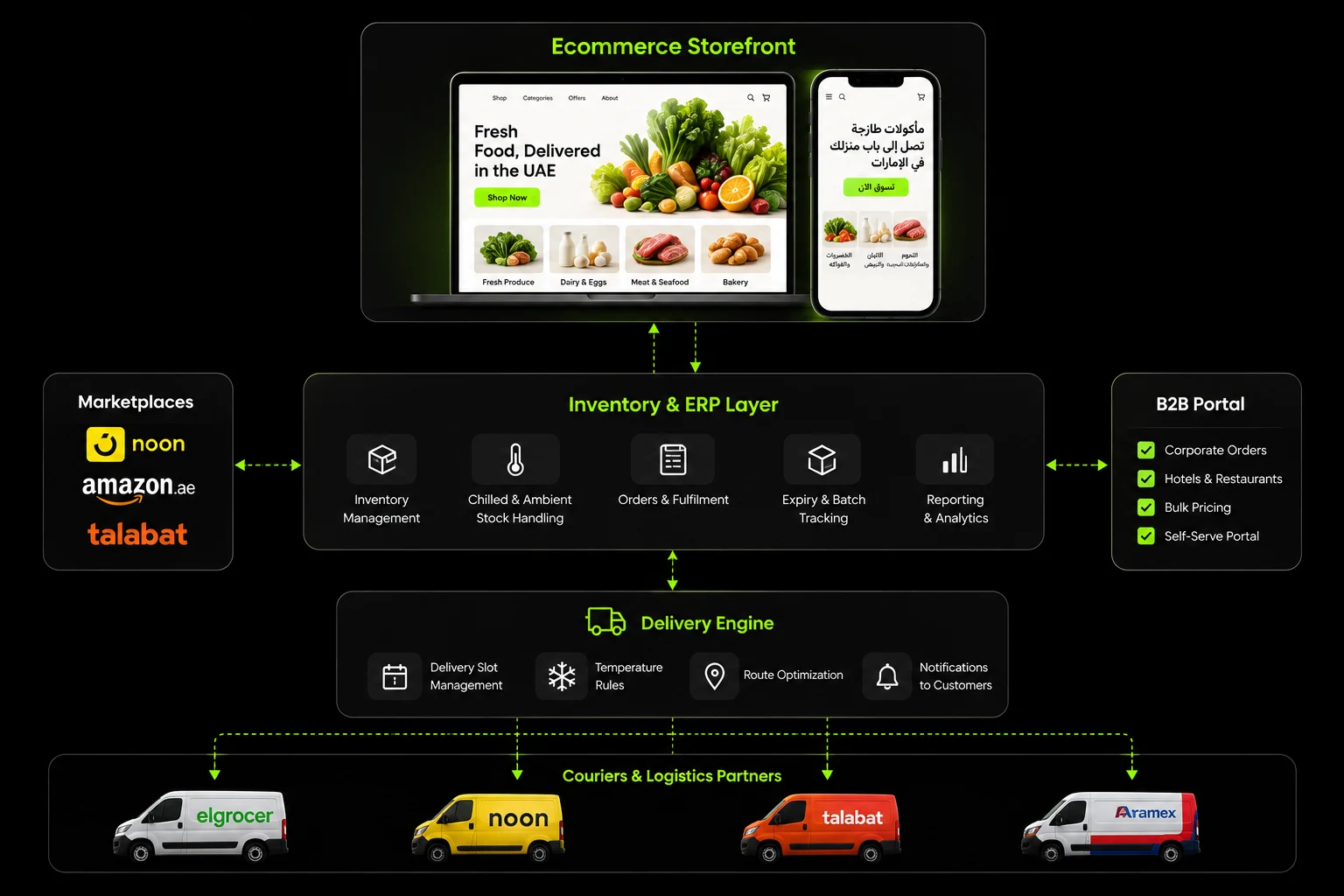
Brands selling through their own stores, Noon, Amazon.ae, and supported quick-commerce partners need reliable stock synchronisation to avoid overselling and cancellations.
An ERP or inventory management system can maintain a shared stock record across channels, depending on available integrations.
Wholesale customers, including cafes, hotels, and restaurants, may also need customer-specific price lists, minimum order quantities, payment terms and VAT-compliant invoices.
Shopify Plus offers native B2B capabilities, while other plans may require wholesale apps. Confirm current plan eligibility before finalising the platform.
For brands expanding across countries, international ecommerce setup also needs consideration, particularly for market-specific catalogues, currencies, and store structures.
Where Food Ecommerce Builds Fail (and What It Costs)
Food ecommerce problems often start when the store's systems do not match the way the products are stored, shipped, and sold. Five common failures can lead to wasted stock, refunds, and avoidable operating costs.
1. The Perishable COD Trap
Refused cash-on-delivery (COD) orders are especially costly for chilled and fresh products because they may not be suitable for resale. The business loses the product and pays for delivery and return transport.
Consider an illustrative example: a store ships 1,000 chilled orders monthly, with an average order value of AED 180.
If 30% use COD and 15% of those orders are refused, that means 45 refused orders, representing AED 8,100 in lost sales value each month, before courier costs. The actual stock loss depends on the products' cost price and whether any items can be recovered.
Build Fixes: Disable COD for selected perishable products, require WhatsApp or OTP confirmation before dispatch, or collect partial payment upfront. The right approach depends on the brand's customers and risk tolerance. COD and return-to-origin (RTO) controls are also important parts of ecommerce conversion optimisation in the UAE.
2. Expired or Short-Dated Stock Sold Online
Without batch and expiry tracking, a product can remain available on the website even when its stock is close to expiry or no longer suitable for sale.
The Cost: Refunds, wasted inventory, customer complaints, and potential compliance issues.
Build Fix: Track expiry dates by batch, apply FEFO stock rotation, and prevent expired batches from being sold.
3. Chilled Orders Shipped at Ambient Rates
When every product uses the same shipping profile, chilled items may be sent through unsuitable delivery services or charged at the wrong rate.
The Cost: Spoiled products, refunds, and reduced margins.
Build Fix: Use storage-temperature fields to apply the right shipping rules for ambient, chilled, and frozen products. Connect these rules to suitable courier services and packaging requirements.
4. Marketplace Overselling
When inventory is not synchronised across the D2C store and marketplaces, customers can order products that have already sold elsewhere.
The Cost: Cancelled orders, possible marketplace penalties, and reduced customer trust.
Build Fix: Maintain a shared inventory source and synchronise stock across sales channels through an appropriate inventory system or ERP integration.
5. Compliance Data Stored Only in Images
Product labels uploaded as images are difficult to search, translate, and update. If ingredients or allergen information changes, the website may continue displaying outdated details.
The Cost: Inaccurate product information, accessibility problems, and potential compliance risks.
Build Fix: Store ingredients, allergens, nutrition information, and other required details in structured fields, with Arabic equivalents where required. This makes updates easier and keeps product information consistent across the store.

Turning UAE Food Rules Into Website Features
UAE food compliance affects product information, registration, shipping, and payment setup. Each requirement should translate into a clear website feature.
Exact rules vary by product category and emirate, so confirm them with the relevant authority before launch.
Halal Certification and Arabic Labelling
Where required, product pages should display accurate halal certification information. Arabic product details must also match the applicable approved label.
Store ingredients, allergens, and nutrition information in structured fields rather than relying on label images or unverified machine translations.
Building both languages into the product data model makes updates easier. Our guide to Arabic-English ecommerce website developers in the UAE explains the technical considerations for bilingual stores.
Product Registration and Claims
Registration processes vary by product type. Dubai Municipality handles relevant food product processes, while Montaji covers consumer product registration and related services.
Confirm the correct route with the relevant authority before deciding which registration fields the store needs.
Health and nutrition claims also require review. Maintain an approved list of permitted claims to keep product descriptions consistent and avoid unsupported medical promises.
Storage and Licensing
Connect storage requirements to fulfilment rules. Chilled products, for example, may need specific delivery profiles, packaging, and suitable couriers.
Confirm the required ecommerce licence and payment provider requirements before launch. Brands delivering to Abu Dhabi should also check applicable requirements with ADAFSA. Shopify store launch guide covers how business readiness fits into the launch process.
Choosing the Platform for a UAE Food Brand
Choose your platform after defining the inventory, delivery, subscription, and sales-channel requirements. The right choice depends on how complex your operations are, not just how quickly you want to launch.
Shopify: Can suit brands with straightforward catalogues, subscriptions, and standard fulfilment needs. More complex requirements, such as expiry tracking, cold-chain delivery slots, and wholesale pricing, may need additional apps or integrations.
WooCommerce: Offers flexibility for customised product data and workflows, but managing multiple plugins can increase maintenance and compatibility work.
Salla and Zid: are worth evaluating for brands targeting Arabic-speaking markets. Check their current payment, courier, subscription, and wholesale capabilities against your requirements before committing.
Custom Development: makes sense when your delivery or inventory processes cannot be handled reliably through an existing platform and suitable integrations. For many brands, a platform-based build is sufficient and more economical.
Compare Shopify with regional platforms or a custom build to Shopify vs Salla, Shopify vs Zid and Shopify vs custom ecommerce development can help you evaluate the trade-offs. You can also explore our Shopify development services.
Build Process, Timeline and Cost
A food ecommerce build works best when operational requirements are settled before design and development begin. Changes to inventory, delivery rules, or integrations later in the project can increase both costs and launch time.
The Seven Build Stages
- Operations Scoping: Define the product catalogue, storage requirements, delivery zones, and sales channels.
- Data and Integrations: Plan product fields, inventory tracking, and connections to other systems.
- Design: Plan product pages, navigation, and the shopping experience.
- Development: Build the store and configure the required apps and integrations.
- Arabic Content: Prepare and verify Arabic product information where required.
- Testing: Test chilled, ambient, mixed-cart, COD, subscription, and B2B orders.
- Soft Launch: Process a controlled number of orders, resolve issues, and prepare for wider sales.
Testing deserves particular attention. A successful test order for an ambient product does not confirm that chilled delivery, mixed carts, or subscription orders will work correctly.
Typical Development Timelines
These are indicative estimates. Actual timelines depend on integration complexity, content readiness, testing requirements, and how quickly business decisions are made.
Licensing and product registration should also begin early. Delays in approvals can push back the launch even when the website is ready.
What Drives the Cost?
The main cost factors are:
- Delivery Functionality: Zones, time slots, order cut-offs, and capacity limits.
- Inventory Integrations: Batch tracking, expiry management, and ERP or warehouse management systems.
- Subscriptions: Recurring orders that fit delivery schedules.
- Wholesale Functionality: Customer-specific pricing, minimum order quantities, and payment terms.
- Bilingual Content: Arabic product information and the work needed to maintain both languages.
- Product Photography: Images that accurately represent packaging, product details, and presentation.
A store selling ambient products through one channel will generally require less functionality than one managing chilled deliveries, multiple marketplaces, and wholesale accounts.
Budgeting should also account for recurring app subscriptions, platform fees, integration maintenance, and ongoing support.
These expenses can add up after launch, so include them when estimating the total cost of ownership. The final budget will depend on the features required, the chosen platform, and how much custom development is necessary.
The same applies to timelines: a clear scope, ready-to-use product information, and early decisions about fulfilment can help prevent avoidable delays.
Questions to Ask a Developer Before Building a Food Store
Before choosing a developer, ask how they will handle the operational challenges specific to food ecommerce. These questions can help you understand whether their proposed solution fits your business.
- How will the store track batches and expiry dates and prevent expired stock from being sold?
- How will chilled, frozen, and ambient products be handled in the same cart?
- Can delivery slots have capacity limits, and will subscriptions follow those limits?
- What safeguards would you recommend for COD orders containing perishable products?
- How will inventory stay synchronised across the website, marketplaces, and quick-commerce partners?
- How will halal certification, allergen information, and Arabic product data be stored and maintained?
- Have you built ecommerce stores for food brands, and can you share live examples?
Look for clear answers that explain the proposed systems, integrations, limitations, and costs. If a developer cannot explain how expiry tracking or temperature-sensitive deliveries will work, ask for more detail before agreeing to the scope.
It is also worth asking about testing, ongoing maintenance, and who will manage the integrations after launch. These responsibilities can affect the store long after development is complete.
For a broader set of questions about evaluating developers, the suplex guide on questions to ask an ecommerce agency can help you prepare for agency discussions.
How Suplex Builds Ecommerce Websites for Food Brands
We start with operations scoping. Before anyone designs a page, we map the catalogue, storage types, delivery zones, and sales channels. That map becomes the build brief.
What we build for food brands:
- Product data models with metafields for ingredients, allergens, halal certification, storage temperature, and Arabic equivalents
- Subscription configuration that respects delivery capacity and cut-offs
- Delivery-slot logic with zones, cut-offs, and capacity limits
- Bilingual, halal-aware storefronts
- ERP, marketplace, and courier integrations
Our food and beverage work includes Tea Culture of the World, a 120-tea catalogue built around average order value and lifetime value; Great Lakes, a spirits brand full-stack build; and Kimi Cafe, an iOS and Android app in Dubai. We use only the metrics published in those case studies.
We are based in Dubai. We handle the licensing sequence, payment gateway setup, COD rules, VAT-inclusive pricing and Arabic RTL alongside the build, because these determine whether the store can launch, not just whether it looks finished.
Frequently Asked Questions
What Does an Ecommerce Website for a Food Brand in the UAE Need?
It needs structured product data for ingredients, allergens, halal certification, and Arabic content, along with batch and expiry tracking. Delivery rules must account for chilled and ambient products, delivery slots, and cut-offs. Brands selling across multiple channels also need local payment options, clear COD rules, and synchronised inventory.
Is Shopify Suitable for Food Brands in the UAE?
Yes, Shopify suits many D2C food brands. It supports product variants, subscription apps, bilingual content, and international selling. Batch tracking, expiry management, delivery-slot capacity, and complex cold-chain shipping may require additional apps or integrations. Brands with extensive wholesale or ERP requirements should also evaluate Shopify Plus.
Should I Offer Cash on Delivery for Perishable Food?
COD carries extra risk because refused fresh or chilled orders may not be suitable for resale. Brands can disable COD for selected products, request WhatsApp confirmation before dispatch, or collect partial payment upfront. COD can remain available for shelf-stable products if customers expect it.
Do I Need Approval to Sell Food Online in Dubai?
You generally need an appropriate trade licence with ecommerce activity and must meet the applicable product registration requirements. Dubai Municipality handles relevant food product processes, while supplements may require registration through Montaji. Requirements vary by product and emirate, so confirm the correct process with the relevant authority before launch.
How Long Does It Take to Build a Food Ecommerce Website?
An ambient-only store typically takes 6–10 weeks. A store with chilled delivery slots and subscriptions may take 10–14 weeks, while projects involving ERP integrations, wholesale ordering, and marketplace synchronisation can take 14–20 weeks or longer. Licensing and registration can extend these timelines.
How Much Does It Cost to Build a Food Ecommerce Website?
Costs depend on the store's operational requirements, including delivery logic, inventory integrations, subscriptions, bilingual content, and wholesale functionality. An ambient-only store generally requires less custom development than one managing cold-chain deliveries and multiple sales channels. Compare quotes based on the same scope and include ongoing app and maintenance costs.
Should Food Brands Sell Through Their Own Websites and Marketplaces?
Often, using both makes sense. Marketplaces and quick-commerce platforms can expand reach, while a brand's own website offers more control over customer relationships, subscriptions, and repeat purchases. Synchronised inventory across channels helps prevent overselling and avoidable cancellations.
Hi, I’m Rishabh Jain
I believe great digital experiences have the power to shape perception, build trust, and move businesses forward. That belief led me to found Suplex Design Studio, a global digital design and development studio helping FMCG and D2C brands build websites and digital experiences that are strategic, thoughtful, and commercially meaningful.
I started Suplex at 25 with a clear intent, to create digital experiences that look appealing, work seamlessly, and help D2C businesses grow. By 28, the studio had scaled globally, guided by a strong foundation in integrated design that I developed during my academic journey in London, where I was honoured with the Dean’s Award.
Over the years, I’ve had the opportunity to work with 100+ brands, from Fortune 500 organisations to family-run businesses, helping them build websites, e-commerce experiences, and digital products that create clarity, credibility, and long-term value.
Our work has been recognised internationally, including the Manifest Award (2024), the Clutch Global Award (2025), and features across platforms such as The Dieline, Packaging of the World, and the World Brand Design Society.
None of this would be possible without the people behind the work. I’m deeply grateful to the Suplex team, whose commitment, creativity, and attention to detail turn ideas into meaningful digital experiences every day.
At the heart of our work is a simple philosophy, digital design should be intentional, functional, and built to create real business value. That continues to guide everything we create at Suplex.


































Let’s Make It Happen
E-Commerce Success Stories









Build Your D2C Business The Right Way
Build It With Suplex.


