When Not to Use Shopify: 7 Situations to Watch For
.avif)
When Not to Use Shopify: 7 Situations to Watch For
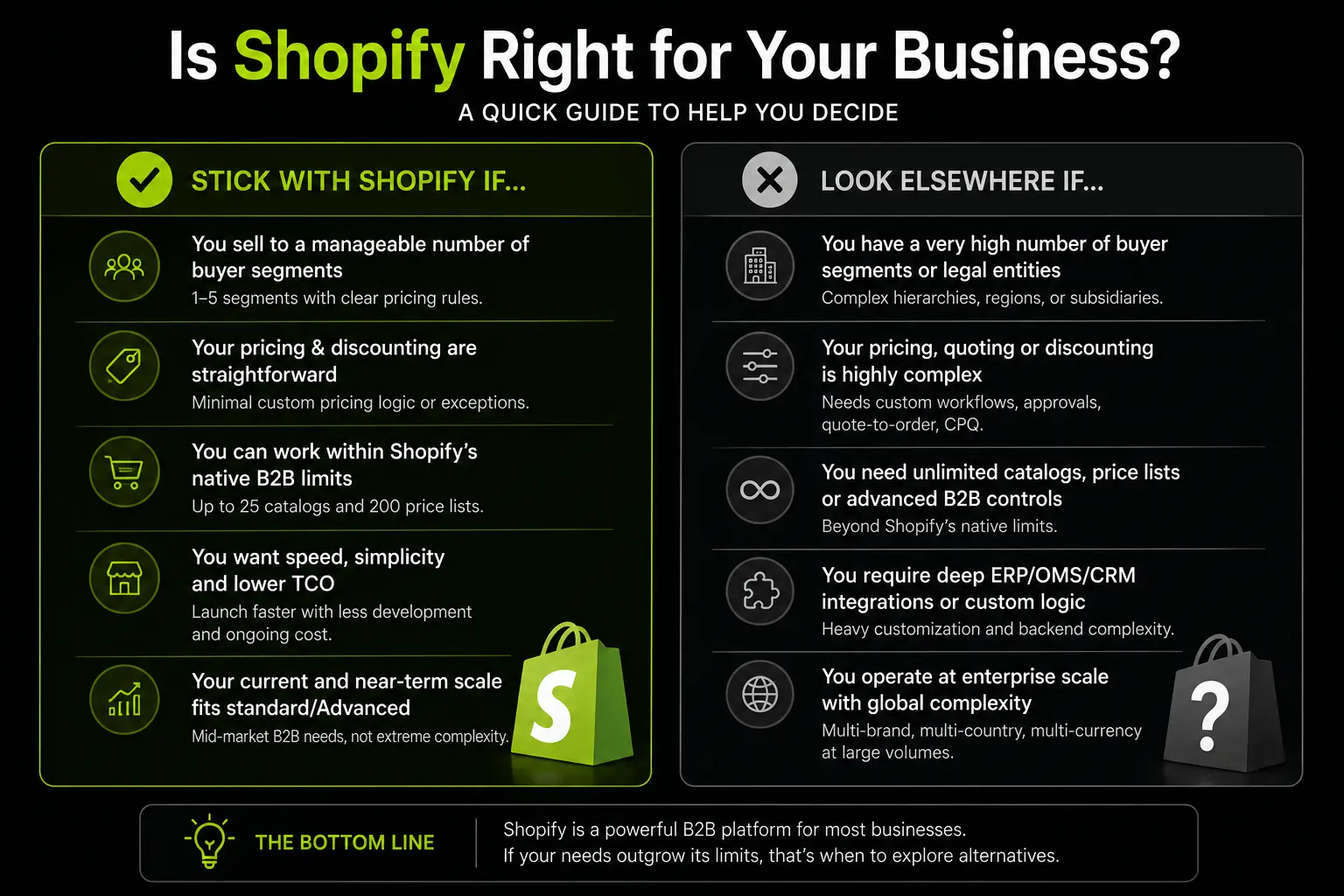
When not to use Shopify depends on a few clear situations.
Shopify works well for most product-based ecommerce businesses, but it has limits when you need content-heavy experiences, highly customised checkout flows, complex B2B workflows or other specialised capabilities.
Use this Suplex guide to check whether Shopify fits your business requirements before you commit to the platform.
Shopify Is Excellent at One Thing, Which Makes the Exceptions Predictable
Shopify was built to sell physical products online, fast, at scale, with minimal engineering overhead. Once you understand that one sentence, every "Shopify limitation" you've read about starts to make sense as a fit problem instead of a flaw.
What Shopify Is Actually Optimized For
Shopify's core strength is speed to launch and reliability at checkout. Hosting, PCI compliance, uptime during traffic spikes and a huge app ecosystem come built in, which is why most D2C brands never need to think about server infrastructure at all.
Look at what Shopify invests engineering time in year over year: checkout speed, payment method coverage, fraud protection and app marketplace depth.
Content tooling, marketplace logic and infrastructure ownership aren't on that roadmap in the same way, because they aren't what the platform is built to solve.
A brand selling skincare, supplements, or apparel with a standard catalog and a standard checkout flow will rarely feel a ceiling here. The platform was built around exactly that use case, and it shows in how little friction those merchants report.
This is also why Shopify's app ecosystem is so deep compared to competitors. Thousands of apps exist specifically because the core platform focuses on doing a smaller number of things extremely well, then leaves the edge cases to third-party developers.
That trade-off works brilliantly for common edge cases. It works less well for edge cases that are genuinely core to how a specific business operates.
Why Most "Shopify Is Bad" Complaints are Actually Fit Problems
Search Reddit for Shopify complaints and you'll find frustrated store owners hitting API limits, checkout restrictions, or content tools that feel thin.
Almost none of them are describing a broken platform. They're describing something Shopify was never built to do in the first place.
Take a common example: a merchant wants to build a bundle-and-subscribe checkout flow with conditional pricing logic that changes based on cart contents. Shopify Functions can handle a lot of this now, but there's a ceiling.
The merchant isn't wrong that it's hard. They're just running into the edge of what a commerce-first platform prioritizes.
The same pattern shows up with content, catalog, and B2B complaints. Each one traces back to a business asking Shopify to be something other than a commerce engine with a storefront attached. That's not a criticism of the merchant's needs.
It just means the fix isn't a Shopify app or a workaround. It's picking the tool that was actually built for that job.
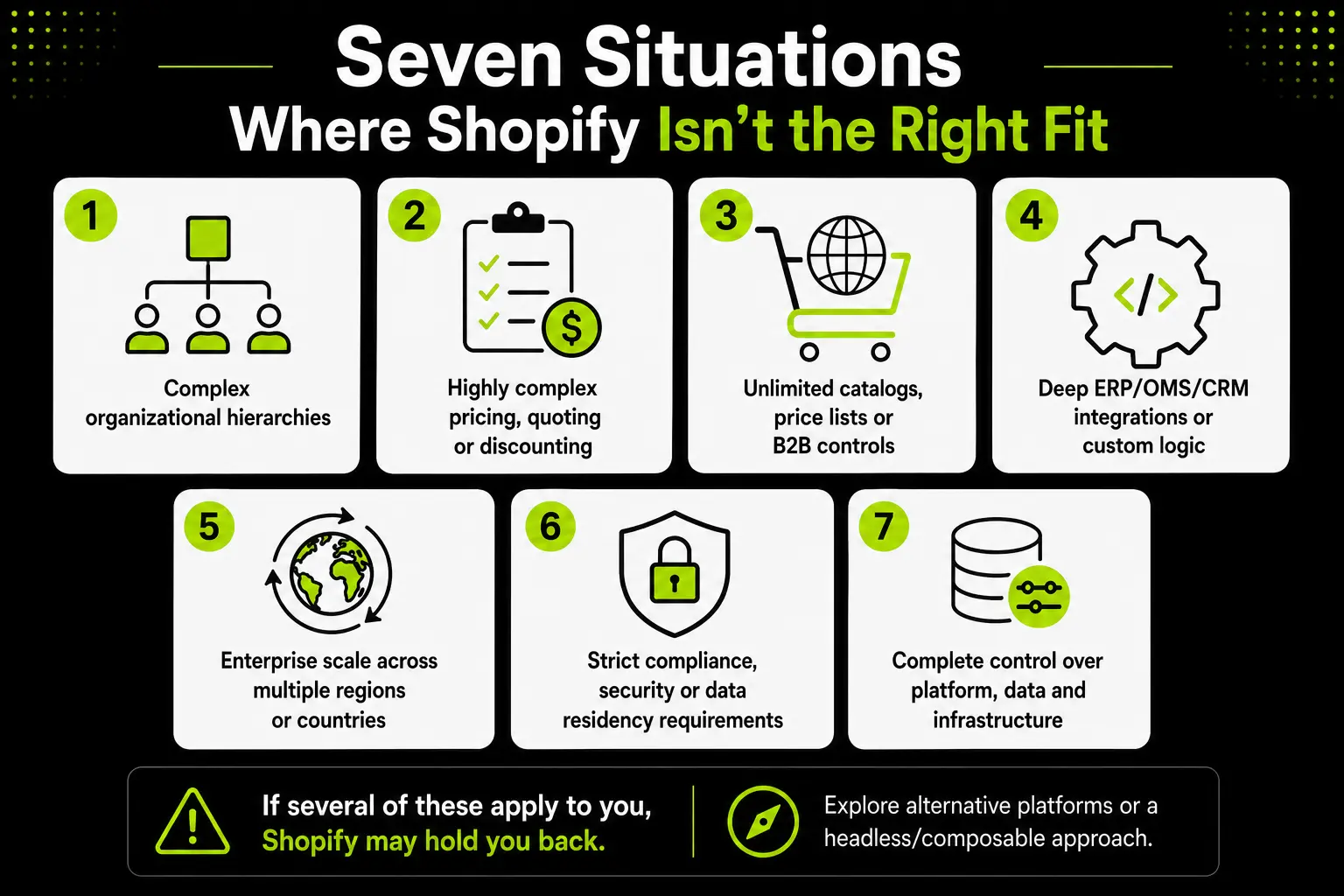
When Not to Use Shopify: Seven Real Situations
These seven situations cover the vast majority of cases where Shopify genuinely becomes the wrong tool. If two or more of these describe your business, it's worth a real platform conversation before you commit to another year on Shopify.
1. Your Business Is Content-First, Not Product-First
If blogging, editorial, resource libraries, or long-form content drive as much of your traffic and trust-building as your product pages do, Shopify's content tools will start to feel thin fast. It has a blog, but it wasn't built for a publication.
A media-and-commerce brand running a recipe library alongside a product line, for example, usually needs custom taxonomies, related-content logic, and editorial workflows that Shopify's CMS doesn't offer natively.
WordPress handles this kind of content depth far more naturally, which is why so many hybrid content-and-commerce brands end up there instead.
The test isn't whether you publish blog posts. Most Shopify stores do that just fine. The test is whether content drives discovery and trust the same way your product pages do. A supplement brand publishing two research-backed articles a month can run entirely on Shopify's native blog without issue.
A wellness publisher running a 200-article resource library, guest contributor workflows, and category taxonomies that need to interlink with product recommendations will hit friction almost immediately, because Shopify's blog was designed as a supporting feature, not a publishing system.
2. You Need Deep Checkout Customization Beyond Shopify Functions
Shopify Functions closed a lot of old gaps around discounting, shipping logic, and payment customization, but it isn't unlimited. Highly specific checkout logic, like multi-step configurators that feed pricing back into the cart in real time, can still hit real walls.
A subscription brand needing complex bundling logic (say, a build-your-own box where quantity discounts change dynamically based on which categories a customer mixes) will often find themselves working around Shopify's checkout rather than building freely within it. A straightforward single-SKU subscription brand, by contrast, usually runs into no friction at all here.
Shopify Functions run on a specific set of extension points: discounts, shipping rates, payment customization, and delivery customization.
That covers most standard use cases. It doesn't cover scenarios where the checkout needs to make decisions based on external data in real time, such as live inventory across multiple warehouses feeding into delivery date promises, or dynamic pricing tied to a customer's loyalty tier calculated outside Shopify entirely.
Those cases need custom middleware or a different checkout layer altogether, and no amount of app-stacking closes that gap cleanly.
3. Your Catalog Has Extreme Complexity
Massive SKU counts, deeply nested product configurators, or highly technical spec sheets (industrial parts, made-to-order furniture, B2B components with hundreds of variant combinations) push past what Shopify's variant and metafield system was designed to manage cleanly.
Shopify variants cap out at a fixed number of option combinations per product. Once a catalog needs true configurator logic (pick a material, then a size, then a finish, each changing available downstream options) most teams end up bolting on third-party apps or, eventually, moving the catalog logic somewhere more flexible.
A furniture brand offering made-to-order pieces across ten fabric options, four leg finishes, and three sizes is already looking at over a hundred combinations per design, before accounting for fabric-dependent price changes or finishes that aren't available on every size.
Metafields can carry some of this, but the presentation logic (hiding invalid combinations, updating price live, showing accurate lead times per configuration) usually needs a PIM system or custom product logic layered on top.
Our product catalog structure guide covers how to model this kind of complexity properly, whichever platform you're on.
4. Your B2B Operation Has Outgrown Even Shopify Plus's Native Tools
Shopify Plus closed most of the historical B2B gaps: company accounts, tiered pricing, and net payment terms are all native now.
But partial payments, complex multi-step quoting, and highly custom approval chains still push some wholesalers toward dedicated B2B platforms.
If your sales team spends real time working around missing quoting logic instead of using it, that's the signal. Cost alone isn't the ceiling here.
Workflow gaps are. Our B2B ecommerce website features guide that breaks down what a business-buyer storefront actually needs to convert, and where native Shopify B2B still falls short.
A distributor requiring a 30% deposit with the balance due on delivery, or a manufacturer needing multi-tier approval before a purchase order clears, is describing a workflow that most dedicated B2B platforms handle as a core feature.
On Shopify Plus, both usually need custom development or a third-party app layered on top. That's not a dealbreaker by itself. It becomes one when the workaround starts costing more in engineering time than a dedicated platform would have cost outright.
5. You're Building a Marketplace, Not a Storefront
Shopify is built for single-brand storefronts. Multi-vendor marketplaces need vendor onboarding, split payments, individual seller dashboards, and commission logic that Shopify simply doesn't offer out of the box.
Apps can bolt some of this on, but they tend to feel bolted on, because they are. A true marketplace model (multiple independent sellers, one shared storefront) is one of the cleanest, least debatable reasons to look outside Shopify entirely.
There's an important distinction worth making here: a curated multi-brand storefront, where you buy inventory wholesale and resell it under one roof, is not a marketplace in the technical sense, and Shopify handles that fine.
A true marketplace, where sellers keep their own inventory, set their own prices, and get paid out individually after your commission, is a fundamentally different data model.
Our marketplace vs own ecommerce site guide walks through this distinction and which model actually fits different business types.
6. You Need Full Ownership of Infrastructure and Data Hosting
Some businesses have hard requirements around data residency, custom hosting environments, or infrastructure they fully control, often for regulatory or enterprise procurement reasons. Shopify is a managed, hosted platform. You don't own the servers, and you can't move them.
For most brands this never matters. For businesses in regulated industries or those selling into enterprise clients with strict vendor requirements, it can be a hard blocker rather than a preference.
Enterprise procurement teams sometimes require specific data residency, custom security audits, or integration with internal systems that a hosted SaaS platform simply can't accommodate, no matter how strong its own security posture is.
If a signed contract depends on infrastructure control you don't have, no amount of Shopify app configuration solves it. That's a genuine architectural decision, not a workaround problem.
7. Your Margins Can't Absorb Transaction and App Costs at Your Volume
Shopify's transaction fees, third-party payment gateway surcharges, and the stack of paid apps most stores end up running all add up. At high volume with already-thin margins, that stack becomes a real cost, not a background annoyance.
We broke down the full cost picture in our hidden costs of Shopify guide, and it's worth running your own numbers before assuming a switch would actually save money once development and maintenance are factored in.
Run the math before deciding anything. A grocery or FMCG brand processing high order volume at low average order value feels every basis point of transaction fee far more acutely than a jewelry brand doing a tenth of the orders at ten times the order value.
The app tax matters just as much: five or six paid apps at $30 to $80 a month each is a real monthly line item once volume climbs, and it's often the first thing worth auditing before blaming the platform itself.
What "Not Shopify" Actually Looks Like
Moving off Shopify doesn't mean picking randomly. Each alternative solves a different specific mismatch, and picking the wrong one just trades one set of limitations for another.
WordPress and WooCommerce: When Content and Commerce Need to Coexist
WordPress's content tools (custom post types, editorial workflows, deep taxonomy control) are built for publishers first, which makes it the natural fit for content-first businesses.
WooCommerce adds commerce on top without forcing you to compromise on the editorial side. See our Shopify vs WordPress comparison for a full breakdown of where each platform wins.
Webflow: When Design Flexibility Matters More Than Commerce Depth
Webflow gives you pixel-level design control without needing a developer for every layout change, which makes it a strong fit for brand-led businesses where the site itself is a core part of the pitch.
Its ecommerce layer is lighter than Shopify's, so it fits best when design flexibility matters more than deep commerce logic. Our Webflow vs Shopify comparison covers this trade-off in detail.
Custom-Built Platforms: When the Business Logic Is Genuinely Unique
Marketplaces, complex configurators, and businesses with genuinely unique operational logic (not just unusual preferences) are the clearest case for custom development. It costs more up front and takes longer to launch, but it removes the ceiling entirely instead of working around one.
When These Situations Don't Actually Apply
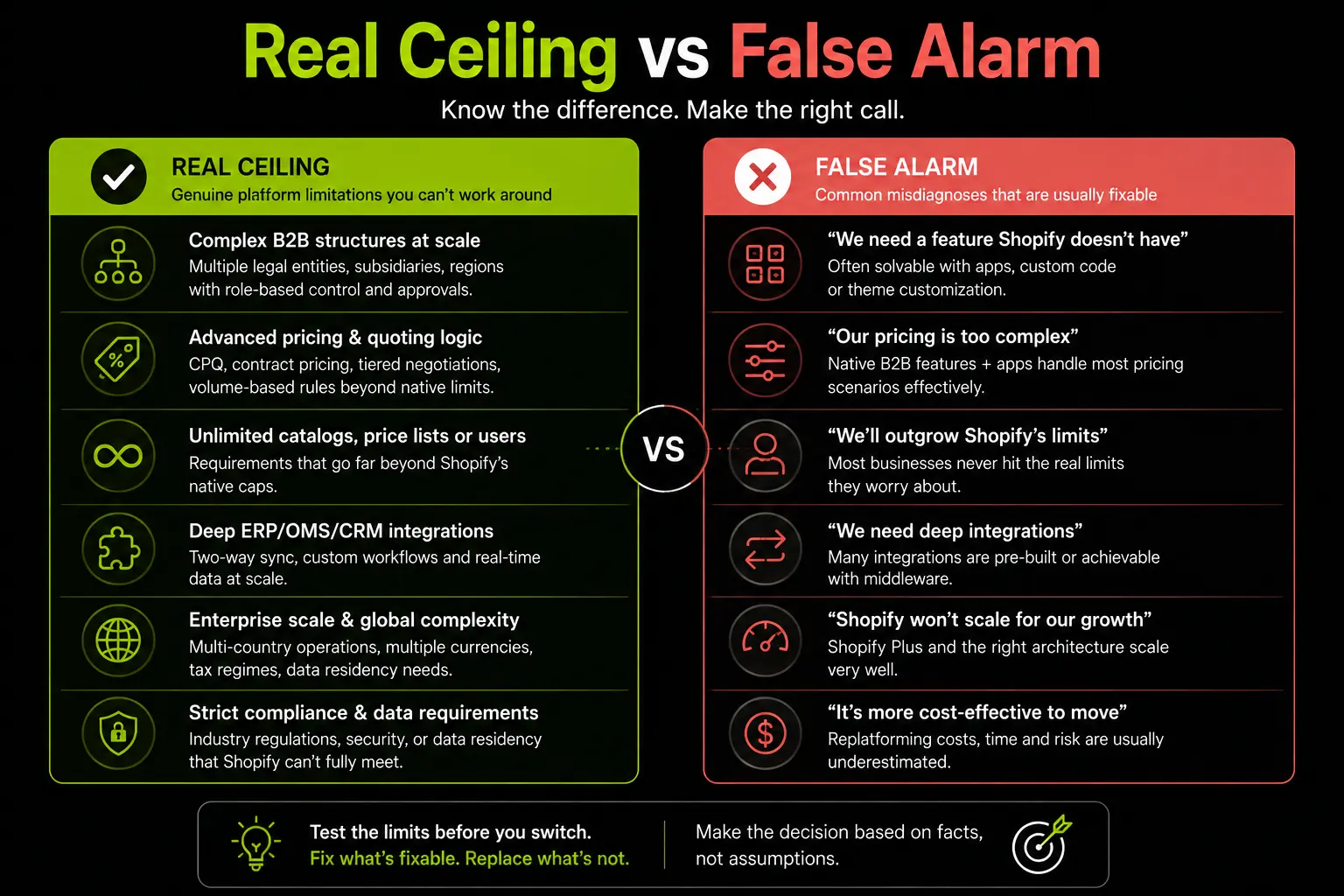
Not every frustration means you've outgrown Shopify. These three false alarms account for a lot of the "should I switch" questions we hear, and most of the time the honest answer is no.
"Shopify Fees Feel High" Isn't Always a Platform Problem
High fees usually mean an app stack that's grown unchecked or a payment gateway setup that isn't optimized, not a platform failure. Before assuming you need to switch, audit what you're actually paying for and whether it's still earning its keep.
Pull up your last three months of app charges and payment processing statements before you touch anything else.
Most stores we audit are running at least one app that duplicates a feature Shopify already includes natively and at least one gateway surcharge that a different payment setup would avoid entirely. Fixing that math often closes most of the gap that feels like a platform problem.
Wanting More Design Control Doesn't Always Mean You've Outgrown Shopify
Custom Shopify themes, built properly, can achieve most of what merchants think only Webflow or custom code can do. The gap is usually in execution, not in what the platform technically allows.
Liquid, Shopify's templating language, supports far more layout flexibility than the average out-of-the-box theme suggests. Most "Shopify feels restrictive" complaints trace back to a store running a lightly customized off-the-shelf theme rather than one built around the brand's actual design system.
A properly built custom theme closes most of that gap without touching the platform itself. See our custom Shopify themes guide for what's actually possible before assuming a rebuild elsewhere.
Most B2B Needs Now Fit Inside Native Shopify B2B (Post-April 2026)
Shopify's native B2B tools closed enough gaps that most wholesalers no longer need a dedicated B2B platform. Real ceilings still exist (situation four above), but they're narrower than they used to be, and they're worth checking against your actual workflow, not assumptions carried over from an older version of Shopify B2B.
Company accounts, tiered and customer-specific pricing, net payment terms, and quantity rules are all native features now.
If your current frustration is with something built before April 2026, it's worth re-checking against the current feature set before assuming the gap still exists. A lot of merchant advice circulating online is simply out of date.
How We Help Brands Choose the Right Platform at Suplex
We're a Shopify-focused agency and we still tell merchants when Shopify isn't the right call. That's only possible because we also build on WordPress, Webflow, and fully custom stacks, so the recommendation follows your business rather than our own incentive to sell one platform.
Our platform consultation service starts with your catalog structure, your content needs, and your checkout logic before any platform gets mentioned.
If Shopify fits, we build on Shopify. If it doesn't, we'll tell you that too, and point you toward WordPress, Webflow, or custom development depending on which mismatch you're actually dealing with.
A Quick Self-Check Before You Decide
Run your business against these six signals. The more that apply, the more worth having a real platform conversation before renewing anything.
If none of these describe you, the honest answer is that Shopify is still your best option. Fix the setup problem instead of the platform.
Frequently Asked Questions
Is Shopify a Bad Platform for Ecommerce?
No. It's a strong default for most product-based ecommerce businesses. It becomes a poor fit in specific situations, like content-heavy businesses, marketplaces, or extreme catalog complexity, rather than being broadly bad.
When Should I Consider WordPress Instead of Shopify?
When content, such as blogging, editorial work, or resource libraries, is as central to the business as the product catalog itself. WordPress's content tools go significantly deeper than Shopify's, which is built commerce-first.
Is Shopify Good for Building a Marketplace?
Not natively. Shopify is built for single-brand storefronts. Multi-vendor marketplaces need a dedicated marketplace platform or significant custom development to handle vendor management and split payments.
Does Shopify Plus Solve All the Limitations of Standard Shopify?
Most of them, but not all. Plus removes several ceilings, including catalog limits, checkout customization, and higher API limits, but real constraints remain around partial payments, complex quoting, and true infrastructure ownership.
Are Shopify's Transaction Fees a Reason to Switch Platforms?
Sometimes, at high volume with thin margins, but not always. Calculate your actual cost stack before assuming a different platform would be meaningfully cheaper once development and maintenance are factored in.
How Do I Know If My Business Has Outgrown Shopify?
Look for genuine functional ceilings, not just frustration: checkout logic you can't implement, catalog complexity you're working around rather than solving, or B2B needs beyond native tools. Cost alone rarely means you've outgrown it.
What's the Biggest Reason Businesses Regret Choosing Shopify?
Usually a platform-fit mismatch is made early, before the business model is fully clear. This often happens with content-first businesses defaulting to Shopify because it's popular, then hitting content tooling limits later.
Hi, I’m Rishabh Jain
I believe great design has the power to shape perception, build trust, and move businesses forward. That belief is what led me to found Suplex Design Studio, a global branding and packaging studio working with FMCG and D2C brands across markets.I started suplex at 25 with a clear intent, to create design that is strategic, thoughtful, and commercially meaningful. By 28, the studio had scaled globally, guided by a strong foundation in Integrated Design that I developed during my academic journey in London, where I was honoured with the Dean’s Award.
Over the years, I’ve had the opportunity to work with 100+ brands, from Fortune 500 organizations to family-run businesses, helping them build packaging and brand systems that create recall, relevance, and long-term value.
Suplex’s work has been recognized internationally, including the Manifest Award (2024), the Clutch Global Award (2025), and features on platforms such as Packaging of the World, The Dieline, and the World Brand Design Society.
None of this would be possible without the people behind the work. I’m deeply grateful to the suplex team, whose commitment, creativity, and attention to detail turn ideas into meaningful brand experiences every day.
At the heart of my work is a simple philosophy, design should be intentional, honest, and built to last, and that continues to guide everything we create at suplex.




































Let’s Make It Happen
E-Commerce Success Stories

%201.avif)






.avif)

.avif)
Build Your D2C Business The Right Way
Build It With Suplex.


