12 Common Reasons for Low Conversion Rates on Shopify Stores in the UAE (and How to Confirm Each One)

12 Common Reasons for Low Conversion Rates on Shopify Stores in the UAE (and How to Confirm Each One)
Low conversion rates on UAE Shopify stores are not always caused by poor design. The problem may be irrelevant traffic, inaccurate tracking, missing payment options or checkout issues that prevent customers from completing their orders.
Changing themes or adding apps without identifying the cause can waste time and money. The first step is to understand where shoppers drop off and why.
This Suplex guide covers 12 common reasons for low Shopify conversion rates, how to confirm each issue using Shopify or GA4 data, and the first steps to fix it, with a focus on the UAE market.
First, Is Your Conversion Rate Actually Low?
Before changing your Shopify store, confirm that its conversion rate is genuinely underperforming. Benchmarks provide context, but your own performance history is a more useful starting point.
Benchmarks, Briefly
Conversion rates vary by product category, price point, and customer intent. Beauty, fashion, and luxury brands can have very different results, so a single industry-wide average may be misleading.
As a Dubai based ecommerce agency, here's our guide to average ecommerce conversion rates by industry exploring these differences. Treat benchmarks as a reference, not a target every store must meet.
Your Trailing Baseline Matters More Than Any Benchmark
Compare the last 30 days with the previous 90 days, splitting the data by traffic source and device. A store-wide conversion rate can hide important changes.
For example, increasing cold traffic from paid social campaigns can lower your overall conversion rate even when the store experience has not worsened. Returning customers and email visitors may convert at very different rates from first-time visitors.
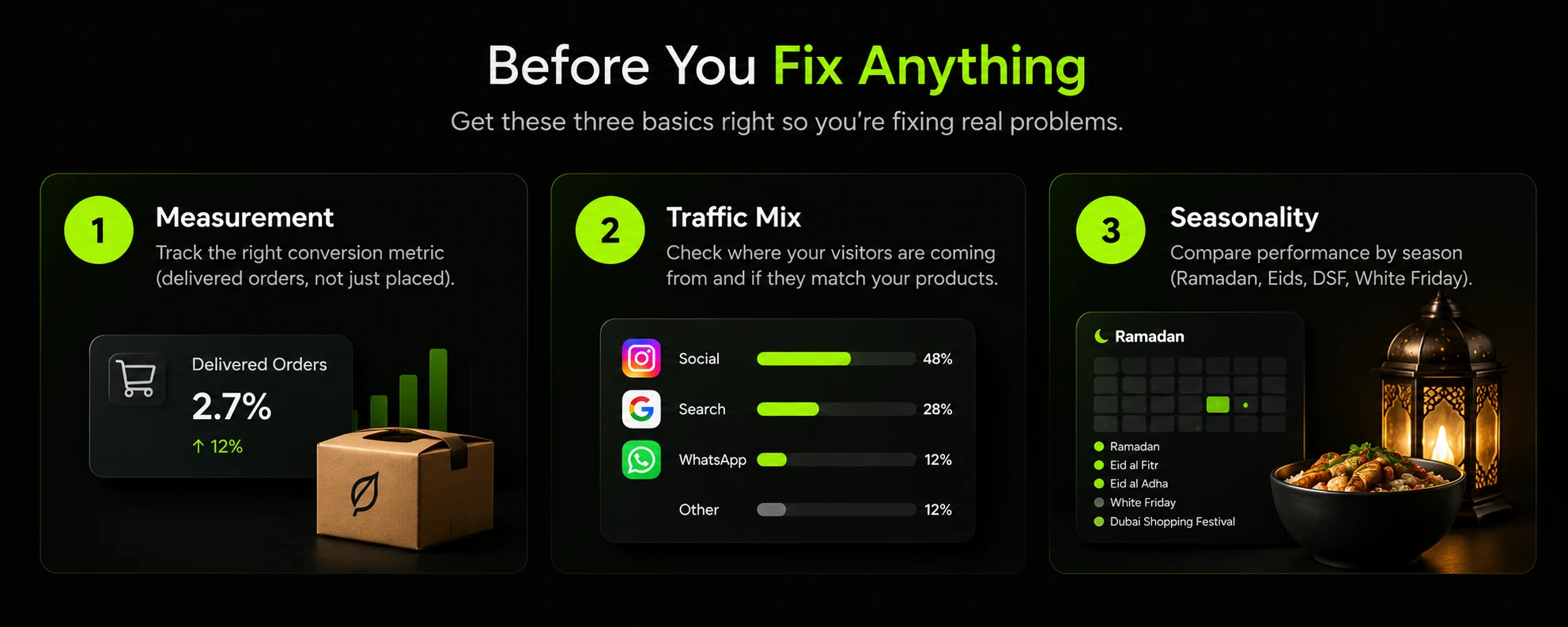
Before changing the website, check three things:
- Measurement: Are Shopify and GA4 recording purchases accurately?
- Traffic Mix: Have your acquisition channels, campaigns, or visitor types changed?
- Seasonality: Is the decline part of a normal seasonal pattern?
These checks can reveal whether the problem lies in tracking, incoming traffic, or the shopping experience itself.
The Quick Diagnosis Table: Match Your Symptom to the Likely Reason
Use this table to identify which issues are most likely affecting your Shopify store. Match the symptoms in your data to the relevant reasons, then investigate those first.
Start with the symptom that most closely matches your data rather than changing several things at once. Once you identify the likely cause, investigate the relevant section before deciding what to fix.
If you want to understand how these issues fit into a broader diagnosis and improvement plan, Shopify conversion rate optimisation guide covers the wider process.
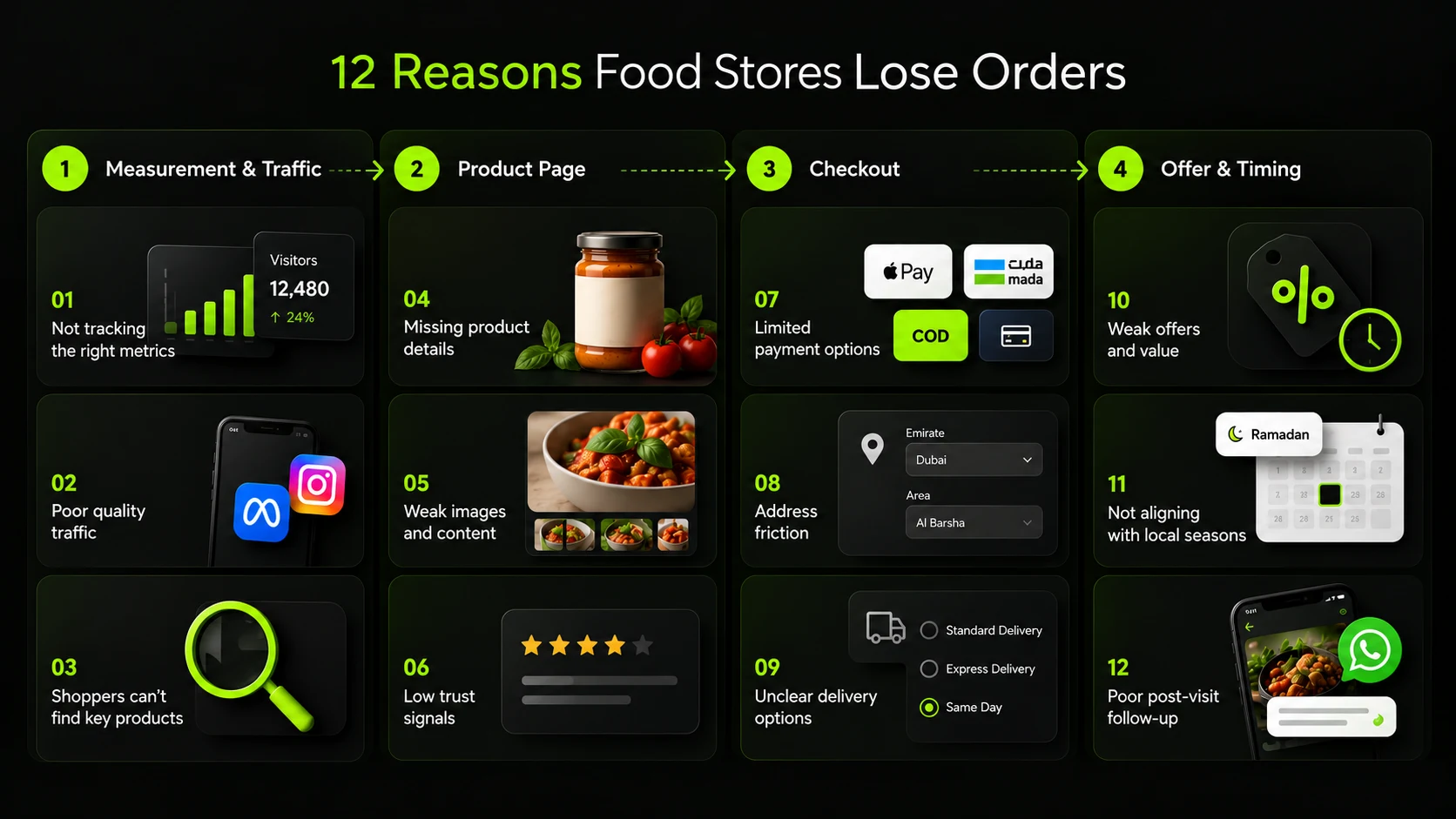
12 Common Reasons for Low Conversion Rates on Shopify Stores in the UAE
A low Shopify conversion rate does not always mean your website needs a redesign. The problem could be inaccurate tracking, poor-quality traffic, slow mobile pages, missing payment options or checkout friction.
For UAE stores, local factors matter too. Delivery costs can vary by emirate, customers may expect cash on delivery or buy-now-pay-later options, and a checkout built around postal codes can create unnecessary friction.
Before changing your theme or increasing your ad budget, find out where shoppers are dropping off. Here are 12 common reasons for low Shopify conversion rates in the UAE, how to identify each problem and what to fix first.
1. Your Tracking Undercounts Sales, or Bots Inflate Your Sessions
If Shopify and GA4 show different order numbers, sessions suddenly spike without sales, or traffic comes from countries you do not serve, check your tracking before changing the store.
How to confirm it
- Compare Shopify orders with GA4 purchase events for the same period. A large gap needs investigation.
- Check traffic by country and referrer for unusual spikes.
- Look for direct traffic with a 100% bounce rate and almost no time on site.
- Test whether your consent banner affects analytics tracking.
In the UAE, Cash on delivery (COD) makes measurement more complicated. A placed order is not necessarily a completed sale if the customer refuses delivery. Track both placed-order conversion and delivered orders divided by sessions.
Fix First: Check your GA4 purchase event setup, remove obvious bot traffic from reporting where appropriate, and include delivered orders in your reporting.
Your measurement setup should be reliable before you start diagnosing other problems. Suplex’s Shopify conversion rate optimization guide covers the metrics worth tracking.
2. Your Traffic Was Never Going to Buy
Conversion can fall after you increase ad spend, even when the website has not changed. Influencer campaigns and discount-led promotions can also bring visitors who have little intention of buying.
How to confirm it
Compare conversion by channel, campaign, country and device. Look at paid traffic separately from email and direct traffic. If the decline is concentrated in one campaign, the problem may be the traffic mix rather than the store itself.
In the UAE, common issues include targeting the entire GCC when you only deliver within the UAE, running ads in English that lead to Arabic pages, or attracting bargain hunters through discounts.
Fix First: Narrow geographic targeting to your delivery areas and make sure each landing page matches the promise in the ad. Judges paid campaigns by revenue per session and profitability, not just the overall store conversion rate.

3. Mobile Pages Are Slow, Often Because of Apps
If mobile conversion is much lower than desktop conversion, page speed and mobile usability deserve attention. Apps can add scripts and other elements that slow down a store, including code left behind after an app is removed.
How to confirm it
- Check Shopify’s Web Performance report.
- Test your store on a real phone using mobile data.
- Check the shopping journey on both iOS Safari and Android Chrome.
- Review installed apps and look for unused scripts in your theme.
Mobile is an important shopping channel in the UAE, although reported shares vary depending on how purchases and traffic are measured.
What to fix first: Remove unused apps and leftover code, compress large images and videos, and avoid showing pop-ups before shoppers have had time to engage.
If speed is a likely cause, start with the practical steps in Suplex’s Shopify speed optimization guide.
4. Product Pages Do Not Answer UAE Buyer Questions
A product page can attract plenty of visitors and still generate few add-to-cart actions. This often happens when shoppers cannot find the information they need to make a decision.
How to confirm it
Watch session recordings, compare exit rates across product pages and review questions customers ask through WhatsApp or customer support.
The UAE shoppers may want to know:
- Whether the displayed price is in AED and includes VAT.
- When delivery will reach their emirate.
- How returns and refunds work.
- Whether a fragrance, luxury item or electronic product is authentic.
- Which instalment options are available.
What to fix first: Put delivery information and the returns policy close to the purchase button. If you offer buy-now-pay-later (BNPL), show the installment information beside the price rather than making shoppers search for it.
These changes are part of the broader approach covered in Suplex’s guide to improving ecommerce conversion rates in the UAE.
5. New Visitors Do Not Trust the Store
Returning customers may already know your brand, but first-time visitors need a reason to trust it. If returning visitors convert much better than new ones, trust could be one of the issues.
How to confirm it
Compare conversion rates for new and returning visitors. Also check whether new visitors add products to their carts but leave before checkout.
Shoppers may look for a UAE business address, company or licence details, genuine local reviews, clear Arabic policies where relevant and a WhatsApp number that someone actually answers.
Fix First: Add genuine reviews, clear delivery and returns information, and relevant business details. Make WhatsApp easy to find on product pages, but do not let it cover the purchase button or interrupt the shopping experience.
Trust signals should appear where shoppers need reassurance, not just in the footer. The same principle applies to D2C homepage design for UAE brands.
6. Currency, Pricing or Market Settings Are Wrong
A shopper who sees an unexpected currency or unclear tax treatment may hesitate before adding a product to the cart.
How to confirm it
Visit your store as a UAE shopper and check the displayed currency, pricing and delivery market. Review your Shopify Markets and tax settings to make sure they match how you sell.
AED pricing and clear VAT presentation help shoppers understand the actual price before checkout.
Fix First: Configure the UAE market correctly, display prices consistently in AED, and confirm that your tax settings and price presentation meet the requirements that apply to your business.
If you sell across several countries, review your Shopify Markets setup alongside your tax and currency configuration.
7. The Payment Method Shoppers Want Is Missing or Hard to Reach
When shoppers start checkout but leave at the payment step, the available payment methods and the payment experience are worth investigating.
How to confirm it
Check the checkout funnel, review payment-failure reports from your gateway and place test orders on mobile. Look for failed redirects, confusing steps and payment methods that are missing or difficult to use.
Depending on your UAE customers, digital wallets such as Apple Pay and Google Pay, BNPL services such as Tabby or Tamara, and COD may all matter.
The right mix depends on your audience, product prices and delivery model. Many merchants also rely on third-party payment gateways, which can add redirects or extra transaction costs.
Fix First: Offer the payment methods your customers actually use, make the available options clear, and test every payment flow on a phone.
Check both gateway fees and Shopify’s additional transaction fees when comparing payment setups. The UAE ecommerce payment gateway comparison can help you assess the available options.
8. Surprise Costs Appear at Checkout
Shoppers may be happy with the product and price until an unexpected delivery fee, COD charge or other cost appears at checkout.
How to confirm it
Place a test order using a UAE address and a typical cart. Note every cost that appears after the product page or cart, and check whether delivery fees differ by emirate.
Common surprises include a COD fee shown only at the last step, higher delivery charges outside Dubai and duties on cross-border orders.
Fix: Show delivery costs, the free-shipping threshold and any COD fee before shoppers reach the final checkout steps. If charges vary by location, explain that clearly.
Research has found cart abandonment to be high across ecommerce studies, with unexpected costs among the commonly reported reasons. Making the full cost clear earlier can reduce avoidable drop-offs.
9. The Checkout Form Does Not Fit UAE Addresses or Phone Numbers
A checkout form that expects every shopper to enter a postal code or rejects a valid phone number can stop an otherwise willing customer from placing an order.
How to confirm it
Test checkout with a real UAE address, including the area, building and landmark, and a phone number using the +971 country code. Watch for validation errors or fields that are difficult to understand.
Fix: Configure address fields for UAE customers, make the postcode field optional where appropriate and confirm that phone validation accepts valid UAE numbers.
This is particularly important for COD orders, where accurate contact and delivery details can also help reduce failed deliveries. The practical steps are covered in localising Shopify checkout for UAE customers.
10. Your Arabic Version Is Only Partly Translated
An Arabic storefront can look complete until a shopper reaches checkout, opens a payment widget or receives an order confirmation in English. These language changes can create confusion and reduce confidence.
How to confirm it
Compare conversion by interface language. Then test the complete Arabic journey on a phone: search for a product, add it to the cart, enter checkout details, trigger an error if possible and review the order confirmation.
Check app widgets, payment messages, delivery information and automated emails too.
Fix: Prioritise checkout, payment messages and order notifications. If you cannot provide a consistent Arabic journey yet, it may be better to complete the key steps before actively directing Arabic-speaking shoppers to the store.
A bilingual build involves more than translating product descriptions. Suplex explains the practical considerations in its Arabic-English ecommerce website developers in the UAE.
11. Shoppers Find It Cheaper or Faster Elsewhere
A shopper may like your product but still buy it from a marketplace if the competing offer is cheaper, arrives sooner or feels more convenient.
How to confirm it
Compare your top 10 products with the same or similar products on Noon and Amazon.ae. Check the total price, delivery promise, promotions and return terms, not just the listed product price.
Also review whether shoppers leave your checkout to search for discount codes.
Promotions and coupon codes can influence buying decisions. However, discount-led traffic may not always produce profitable orders or repeat customers.
Fix : Consider bundles, loyalty benefits, exclusive products or useful services that give shoppers a reason to buy directly. Apply eligible discounts automatically where possible, and make the offer clear before checkout.
The right strategy depends on your margins and positioning. Suplex’s comparison of a marketplace versus your own ecommerce site explores the trade-offs.
12. It Is Seasonal, Not Structural
Conversion can change around Ramadan, Eid, summer travel periods and major shopping promotions. A temporary dip does not automatically mean your website has a problem.
How to confirm it
Compare the same period year on year and look at conversion by day and hour. During Ramadan, for example, shopping activity may shift towards later in the evening. Also check whether delivery cut-offs, stock levels or advertising spend changed.
Fix : Avoid redesigning the store based on a short-term seasonal dip. Adjust support hours, promotional timing and delivery messaging where needed.
If the decline is new or much larger than usual, investigate traffic, stock, tracking and checkout changes before assuming it is seasonal.
How Suplex Diagnoses Low-Converting Shopify Stores
Our process starts with a tracking audit, followed by traffic segmentation and a review of where shoppers drop off.
We then walk through the UAE checkout experience, checking payment methods, AED and VAT display, address fields and Arabic-language flow. A speed and app audit comes next, followed by a list of fixes ranked by their likely revenue impact.
As a Dubai-based Shopify agency, Suplex can design and implement the recommended changes rather than simply handing over a report. The goal is to turn findings into practical improvements.
You can start with several checks yourself. Review your tracking, currency settings and UAE checkout fields first. If the cause is still unclear, an outside review can help narrow down what to investigate next.
Our Shopify audit, performance optimisation and D2C data analytics services cover different parts of this process.
Frequently Asked Questions
What Is a Good Conversion Rate for a Shopify Store in the UAE?
There is no reliable public benchmark specifically for UAE Shopify stores, and rates vary by category. Many stores sit between 1% and 3%. A more useful comparison is your own baseline, split by traffic source and device. If you offer cash on delivery (COD), track delivered orders too, since placed orders can overstate actual conversion.
Why Is My Shopify Store Getting Traffic but No Sales?
Common causes include poorly targeted traffic, slow mobile pages, missing trust signals and checkout friction, such as unavailable payment methods or unexpected delivery costs. Check your tracking first to make sure sales are being recorded correctly.
Why Did My Shopify Conversion Rate Drop Suddenly?
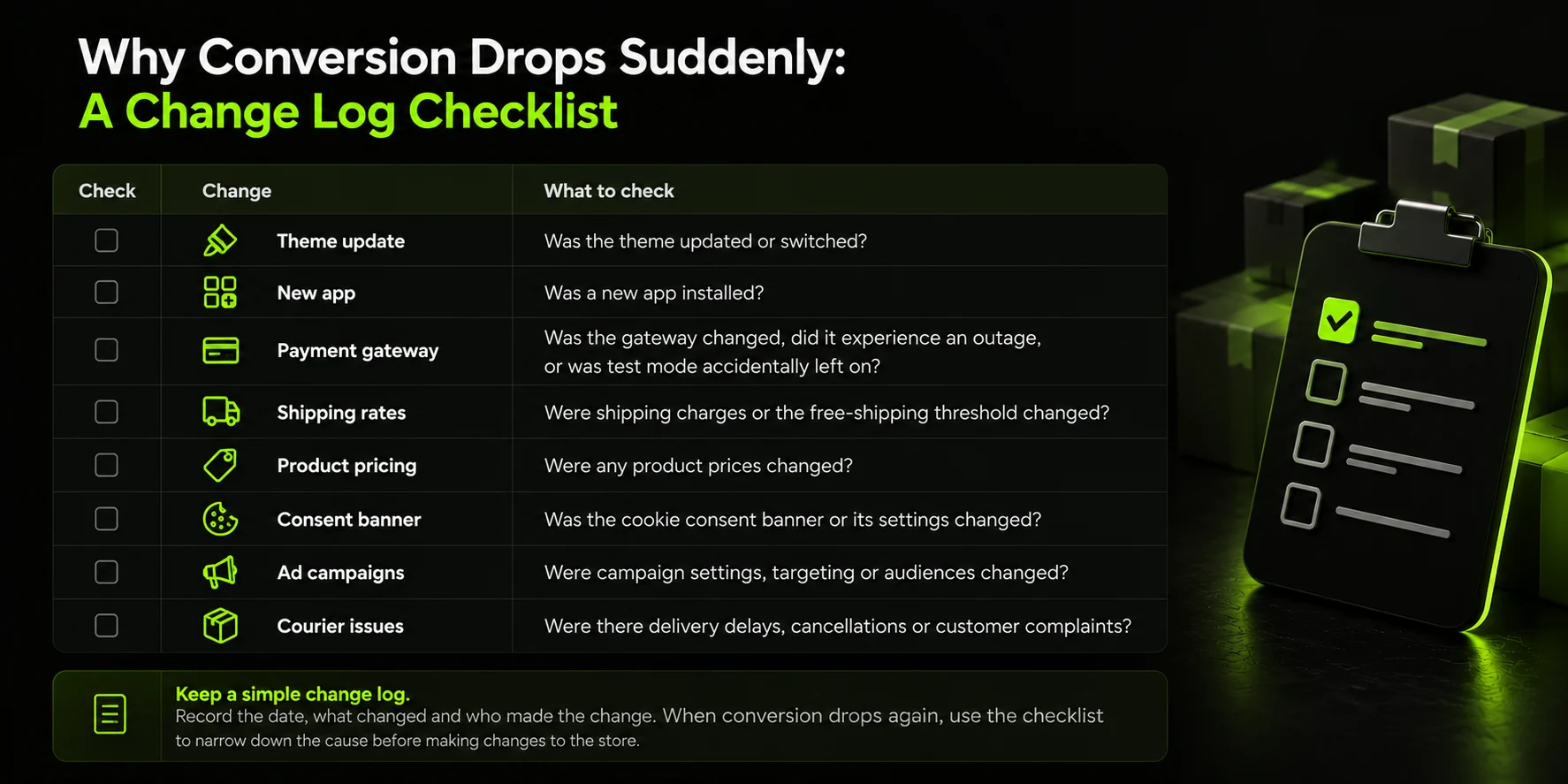
Review changes made just before the drop, including theme updates, new apps, payment gateway issues, shipping changes, consent banner updates or new ad campaigns. Seasonality can also affect UAE buying patterns, so compare performance with the same period last year before changing your store.
Does Offering Cash on Delivery Improve Conversion in the UAE?
COD can encourage first-time buyers to order, but it also increases the risk of failed deliveries. Pair it with order confirmation through WhatsApp or OTP where appropriate, and track your return-to-origin (RTO) rate alongside conversion.
Can a Missing or Poor Arabic Version Lower Conversion?
Yes. If your storefront is in Arabic but checkout, error messages or order notifications switch to English, shoppers may lose confidence. Compare conversion by interface language and fix checkout and notifications first. If you cannot provide a complete Arabic shopping journey, consider pausing the Arabic version until it is ready.
Does a Slow Website Reduce Shopify Conversion Rates?
Yes, particularly on mobile. Common Shopify speed issues include too many apps, leftover code from removed apps, heavy hero videos and unoptimised images. Check Shopify's Web Performance report and test your store on a real phone.
How Do I Know Which Conversion Problem to Fix First?
Start by checking your tracking. Then identify where shoppers drop off: before adding to cart, in the cart or during checkout. Prioritise issues that block customers who are already trying to buy. Change one thing at a time and measure the results over a suitable period.
Hi, I’m Rishabh Jain
I believe great digital experiences have the power to shape perception, build trust, and move businesses forward. That belief led me to found Suplex Design Studio, a global digital design and development studio helping FMCG and D2C brands build websites and digital experiences that are strategic, thoughtful, and commercially meaningful.
I started Suplex at 25 with a clear intent, to create digital experiences that look appealing, work seamlessly, and help D2C businesses grow. By 28, the studio had scaled globally, guided by a strong foundation in integrated design that I developed during my academic journey in London, where I was honoured with the Dean’s Award.
Over the years, I’ve had the opportunity to work with 100+ brands, from Fortune 500 organisations to family-run businesses, helping them build websites, e-commerce experiences, and digital products that create clarity, credibility, and long-term value.
Our work has been recognised internationally, including the Manifest Award (2024), the Clutch Global Award (2025), and features across platforms such as The Dieline, Packaging of the World, and the World Brand Design Society.
None of this would be possible without the people behind the work. I’m deeply grateful to the Suplex team, whose commitment, creativity, and attention to detail turn ideas into meaningful digital experiences every day.
At the heart of our work is a simple philosophy, digital design should be intentional, functional, and built to create real business value. That continues to guide everything we create at Suplex.



































Let’s Make It Happen
E-Commerce Success Stories









Build Your D2C Business The Right Way
Build It With Suplex.


